Boxes by style: rigid
Custom book-style boxes
A book-style box opens like a hardback: a wrapped greyboard case with a spine hinges sideways from a tray fixed inside it. It can lie flat or stand upright on a shelf, and the spine becomes a printed surface. This guide explains the case and tray construction, closures, uses, limits, finishes and inserts, and what to specify. Orders start at 50 boxes.
- Family
- Rigid
- Minimum order
- 50 boxes
- Sizing
- Made to your dimensions

Construction
How it is built
The case
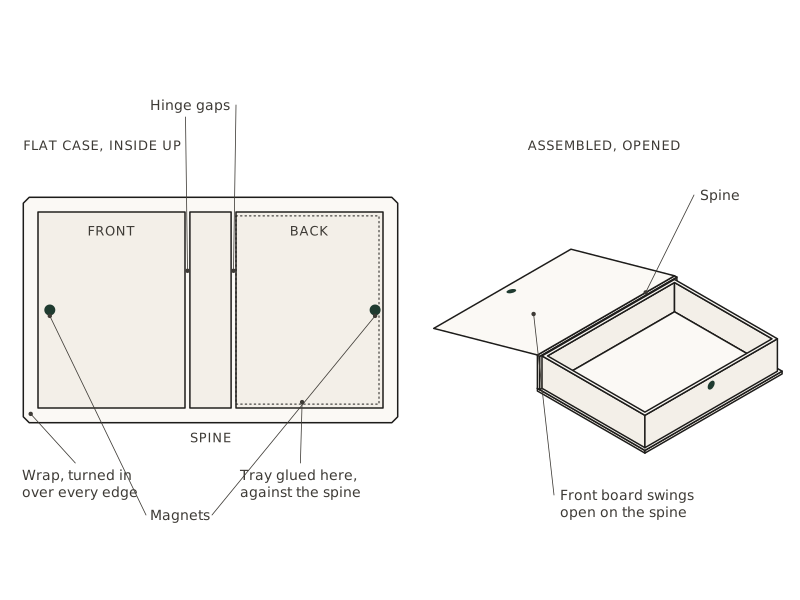
The outer case is made like a book cover: three greyboard panels, the front board, the spine and the back board, laid on one sheet of wrap with small gaps between them. The gaps are the hinges, bridged by the wrap outside and by a liner paper inside, like the endpapers of a book. The boards are cut a few millimetres larger than the tray all round, so the edges overhang slightly as the boards of a book do.
The tray
A wrapped greyboard tray, made like the base of any rigid box, is glued to the inside of the back board and against the spine. Its depth sets the width of the spine, which is cut to the tray depth plus an allowance for the board. Some book boxes add a pocket, flap or shallow second tray on the inside of the front cover to hold a booklet, certificate or card.
Closures
The usual closure is a pair of hidden magnets: one set into the opening edge of the front board and one into the tray wall behind it, both covered by wrap and liner. Alternatives are a magnetic fore-edge flap, a fourth panel that wraps round the opening edge and closes onto the tray face; a ribbon tie glued between the boards; or no closure at all, for heavy covers that stay shut under their own weight.
Book-style or magnetic closure?
Both are one-piece rigid boxes with a hinged, wrapped case, and the trade uses the names loosely. We call a box book-style when the cover hinges along a long side on a spine and opens sideways, so the box can be shelved upright like a book. We call it a magnetic closure box when the lid hinges along the back and lifts upwards, with a flap over the front. Telling us which movement you want avoids confusion at quotation.
Opening and closing
How it opens and closes
Opening
Hold the box like a book and open the front cover from its opening edge: it swings on the spine hinge and lies flat beside the tray, or rests open against the table. If there is a fore-edge flap, it is lifted first. Everything in the tray is shown at once, and the inside of the front cover faces the reader, which makes it a natural place for a printed message, a booklet pocket or an insert card.
Closing
Swing the cover back over the tray. Magnets in the opening edge pull it shut, a ribbon is tied, or the cover simply rests closed under its own weight. The closure holds in normal handling and when the box stands on a shelf, but like any hinged rigid box it is not a transit seal, so boxes that travel are banded, sealed or packed in an outer carton.
Best for
Where book-style boxes work best
Jewellery and watches
Slim book boxes with a lined platform; the book format feels like a keepsake worth keeping.
Stationery and notebooks
Notebooks, pens and cards presented like a volume, with the name printed on the spine.
Collector's and limited editions
Numbered sets and memorabilia that are stored upright on a shelf between uses.
Cosmetics palettes and sets
Slim multi-product sets, with instructions or a shade guide printed inside the cover.
Corporate welcome and launch kits
A presentation kit with a brochure pocket inside the front cover and products in the tray.
Chocolates and tea
Slim assortments in a divided tray, closed with a ribbon tie for a traditional look.
Advantages and limitations
Strengths, and where it falls short
Advantages
- The spine is an extra printed surface, so the box identifies itself when stored upright on a shelf.
- The inside front cover can carry a pocket, booklet or message facing the customer as the box opens.
- Opens flat and presents the whole tray at once.
- A familiar, collectable format that customers keep, file and reuse.
- The flat front board and spine are ideal for foil blocking and debossing, as on a cased book.
Limitations
- Works best in slim proportions: a deep tray needs a wide spine and a heavy cover, so deep products usually suit a lid and base or magnetic closure box better.
- Supplied assembled and cannot be flattened, so storage and freight volume are high.
- Costs more than a folding carton because the case, tray and closure are made and assembled separately, partly by hand.
- The closure is not a transit seal; boxes that are posted need a band or an outer carton.
- Magnets are a non-paper component; a ribbon tie or a weighted cover avoids them if that matters to you.
Materials, printing and finishes
What it is made from and how it is decorated
Materials
Greyboard (chipboard)
Typically 1.5–2.5 mm for the case and tray of most book boxes, up to 3 mm for large or heavy covers. Thicker case boards feel more like a hardback but add weight.
Printed art paper wrap
Coated paper printed in CMYK or Pantone as one continuous sheet across front, spine and back.
Cloth-look and speciality papers
Book-cloth effect, linen-finish and leather-look papers give a bound-book feel and take foil blocking well.
Liner papers
Line the inside of the case like endpapers, plain or printed, and cover the inside of the tray.
Closure components
Hidden disc magnets in the front board and tray wall, or a satin or grosgrain ribbon tie.
Printing
The case wrap is one sheet running across the front, spine and back, so the artwork is set up as a single spread on our dieline, with allowances for the hinge gaps, turn-ins and corners. Text on the spine usually runs from top to bottom, the UK convention for books, so it reads when the box lies face up. The inside of the front cover and the tray liner can be printed separately. Litho gives accurate colour on coated paper; digital print suits very short runs and versions.
Finishes
Soft-touch or matt lamination
A quiet, tactile surface across the case that suits the book format; lamination is included as standard.
Gloss lamination
Deepens colour and photography on a printed cover, like a glossy jacket.
Foil blocking
Titles and logos on the front board and spine, applied with a heated die before the wrap goes on the board.
Debossing and embossing
A blind or foiled deboss on the front board holds well in dense greyboard; embossing is kept shallow so it survives wrapping.
Spot UV
Gloss highlights on a matt or soft-touch cover, for a title or pattern.
Inserts, shipping and packing
Practicalities
Inserts
The tray takes the same inserts as any rigid box: wrapped board platforms, EVA or foam cut to the product, divided card trays and ribbon pulls. Book-style boxes add a second place for content: a pocket, flap or shallow tray inside the front cover for a booklet, certificate or card. Because the box may be stored upright on its spine or edge, each item needs holding firmly enough not to fall out of position when the book is turned.
Shipping
Book-style boxes are delivered assembled in outer cartons. They cannot be flattened, but slim books stack efficiently, like books on a pallet. To send them on to customers, pack each in an outer courier carton or a close-fitting postal box, and band or seal the cover. Delivery is included on every order. Your quotation confirms the delivery address and timing.
Packing and assembly
Open the cover, load the tray and any cover pocket, and close it: hand packing with no folding or tape. Slim boxes stack neatly on the bench and in outer cartons. Where a booklet sits in the cover pocket, check at the sample or proof stage that it clears the tray contents when the cover closes, and allow for it in the depth.
Alternatives
When another style does the job better
Box style
Magnetic closure boxes
Hinged at the back rather than the side, with a lid that lifts upwards. Choose it for deeper boxes that sit flat rather than stand on a shelf.
Compare this styleBox style
Collapsible rigid boxes
Choose it when boxes must arrive and be stored flat; the look is similar but the case folds down.
Compare this styleBox style
Lid and base boxes
Choose it for deep or bulky contents that are lifted out from above.
Compare this styleBox style
Sleeve and slipcase boxes
A slipcase over a box or set is the traditional alternative when the pack should slide into a case rather than open like a cover.
Compare this style
- Internal tray dimensions (length × width × depth) and the weight of the contents.
- Closure: hidden magnets, magnetic fore-edge flap, ribbon tie or none.
- Which side the spine is on, and whether the box will be stored upright.
- Wrap: printed art paper, cloth-look or speciality paper, plus the text for the cover and spine.
- Inside: printed cover liner, and any pocket or second tray for a booklet or card.
- Finishes and positions: lamination, foil blocking, debossing, spot UV.
- Insert layout and what each cavity holds.
- Quantity (from 50 boxes) and your required delivery date.
Finished work
Book-style boxes we have made
Book-style boxes
Book-style boxes questions
Questions buyers ask
Anything not covered here, put it in the notes on your quote and we will answer it directly.
Ask on your quoteWhat is a book-style box?
It is a rigid box made like a hardback book: a wrapped greyboard case with front board, spine and back board, and a tray glued inside the back board. The cover opens sideways on the spine.
How is a book-style box different from a magnetic closure box?
A book-style box hinges on a side spine and opens sideways, like a book, and can be shelved upright. A magnetic closure box hinges along the back and its lid lifts upwards. Either can close with magnets.
Does a book-style box have to use magnets?
No. Hidden magnets are the usual closure, but a magnetic fore-edge flap, a ribbon tie, or a heavy cover with no closure are all options.
Can a book box hold a booklet or card?
Yes. A pocket, flap or shallow tray can be built inside the front cover for a booklet, certificate, instructions or a card, facing the customer as the cover opens.
Can a book-style box stand upright on a shelf?
Yes, that is one of its strengths. The spine can be printed or foil blocked with a name or title, and the insert should hold each item firmly so nothing shifts when the box stands on its edge.
Can book-style boxes be delivered flat?
No, they are supplied assembled. If flat delivery matters, a collapsible rigid box gives a similar look and folds down.
What is the minimum order for book-style boxes?
The minimum order is 50 boxes. Your quotation can show several quantities so you can compare the unit cost.
How long do book-style boxes take?
The case, tray and closure are made and assembled separately, partly by hand, and finishes such as foil blocking add a step. Tell us your required delivery date and our team will confirm whether the timing is achievable.
Ready to specify your packaging?
Our team replies during business hours, 10:00–18:00 UK time.