Folding cartons · tuck end
Reverse Tuck End Boxes
A reverse tuck end box is a one-piece folding carton with a tuck closure at each end, hinged from opposite panels: the top lid from the back, the bottom lid from the front. That layout nests tightly on the press sheet, so it uses less board than a straight tuck and is the most economical printed carton for light products. It ships flat, closes without glue and is made to your dimensions from 50 boxes.
- Family
- Folding carton
- Minimum order
- 50 boxes
- Sizing
- Made to your dimensions
Construction
How it is built
Four panels, one side seam
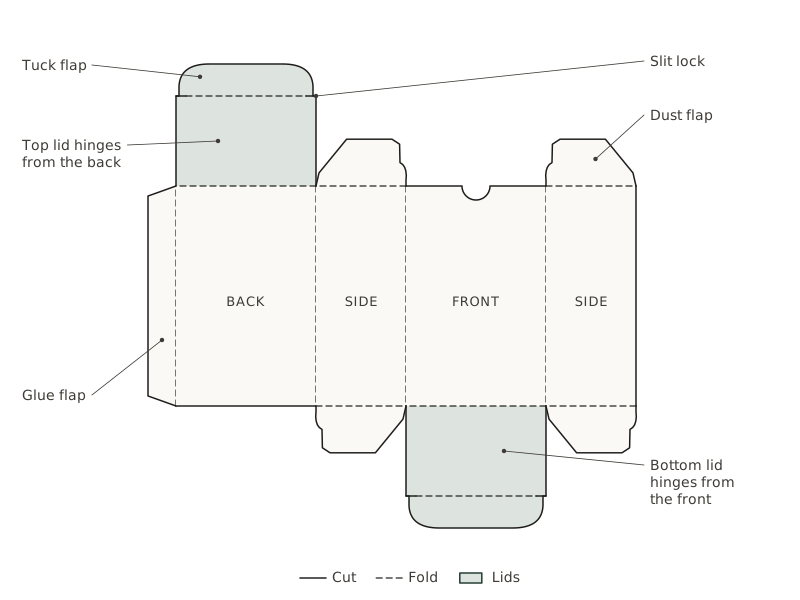
Like every tuck end carton, the reverse tuck is cut and scored from one sheet of board: four body panels in a row with a glue flap on one edge. The folder-gluer bonds the glue flap to the inside of the opposite panel, producing a flattened tube that opens along its vertical scores. Only one straight glue line is needed, which keeps converting simple and quick.
Lids hinged from opposite panels
The top closure panel is hinged from the back panel and tucks in towards the front. The bottom closure panel is hinged from the front panel and tucks in towards the back. So the front panel shows a fold line along its bottom edge, and on the flat blank the bottom lid's artwork runs in the opposite direction to the top lid's. Both are allowed for when the artwork is placed on the dieline.
Why it nests on the sheet
Because the two lids point in opposite directions, neighbouring blanks can be laid head to toe on the printed sheet and interlock with very little waste between them. Board is the largest material cost in a folding carton, so on long runs of small cartons that saving is real. It is the reason reverse tuck became the default format for pharmacy-style and personal-care cartons.
Dust flaps and slit locks
Small dust flaps on the side panels fold in first at each end, closing the corners and supporting the lid. Slits at the shoulders of each tuck's fold line catch on the curved shoulders of the dust flaps as the tongue goes in, so the lid is held by friction and resists springing open. A thumb notch in the top edge of the front panel helps the customer find the top tuck.
Scores, sizing and proportions
Each fold is a score matched to the board's caliper so the carton folds square without cracking. We size the carton to your product with a small clearance, and set the tuck length so it holds firmly without buckling the panel it slides behind. Tall cartons need attention to the ratio of height to footprint, because long, narrow panels in light board tend to bow; heavier board or an insert fixes that.
Opening and closing
How it opens and closes
Opening
The top opens exactly as on a straight tuck carton. The customer lifts the tuck at the front edge, the friction locks release, and the lid hinges back along the top of the back panel to reveal the full opening. The bottom is rarely opened by the customer; it is closed at the packing stage and normally stays closed for the life of the product.
Closing
At each end the dust flaps fold in, the lid folds over them and the tuck slides inside the opposite panel until the locks catch. At the top the lid comes down from the back; at the bottom it comes up from the front and tucks inside the back panel. No adhesive is used anywhere, so the top can be opened and reclosed as often as the product needs.
Best for
Where reverse tuck end boxes work best
Personal-care and pharmacy-style cartons
Tubes, tubs and blister packs sold in quantity, where board efficiency on long runs matters more than the bottom front edge.
Supplements and wellness
Capsule tubs and sachet packs under a few hundred grams, with side and back panels for directions and batch coding.
Cosmetics ranges
Lipsticks, mascaras and small bottles in a family of carton sizes that share one print specification.
Soap and bath products
Wrapped soap bars, bath salts in an inner pouch and small gift sets on the lighter side.
Accessories and spare parts
Light components, cables and refills where a printed carton replaces a plain box and a sticker.
Wrapped confectionery
Individually wrapped sweets or chocolates in a small carton that is opened once and kept.
Advantages and limitations
Strengths, and where it falls short
Advantages
- Uses less board per carton than straight tuck, because the blanks nest head to toe on the sheet.
- One of the lowest-cost closed cartons for light products: one straight glue line and no base gluing.
- Reclosable top held by friction locks, with no glue or tape.
- Ships and stores flat, and erects by hand in seconds.
- The standard format for horizontal end-load cartoning machines, so a design proven by hand can move onto a line later.
- Takes windows, hang tabs and inserts in the same way as other tuck end cartons.
Limitations
- The bottom lid hinges from the front panel, so its fold shows along the front bottom edge; a clean full-height front needs straight tuck.
- The two lids face opposite ways on the flat blank, so artwork on the bottom lid, barcode panel and batch area must be placed with care.
- Like any tuck bottom it is held by friction and suits light contents; heavy or glass items need a crash-lock or snap lock base.
- A front window close to the bottom hinge weakens the panel, so windows are kept well clear of the scores.
- It is retail packaging, not a transit box, and needs a mailer or outer carton for courier delivery.
Materials, printing and finishes
What it is made from and how it is decorated
Materials
Folding boxboard (FBB)
Most reverse tuck cartons use 250–350 gsm folding boxboard: lighter weights for small tubes, 350 gsm and above for larger faces.
Solid bleached board (SBS)
White through its thickness, for inside print, fine detail and crisp scores on small cartons.
White-lined recycled board
A coated white top over recycled fibre, grey on the reverse. Economical where the inside of the carton is not seen.
Kraft board
Unbleached or white-lined kraft for natural ranges; expect deeper, darker print on the brown surface.
Printing
Litho printing in CMYK suits most reverse tuck work, with Pantone spot colours for exact brand colours and consistent ranges across several carton sizes. Digital print handles short runs and multiple versions economically. Because the lids face opposite ways on the blank, the dieline marks the reading direction of every panel, and we check it at proof so the bottom lid, barcode and batch area end up the right way round. Inside print is available as a separate pass.
Finishes
Matt, gloss or soft-touch lamination
A film over the print that protects the carton on shelf and in handling. Lamination is free on every order.
Spot UV
Clear gloss on a logo or pattern, most effective over matt lamination on the front panel.
Foil blocking
Metallic foil on a brand mark or product name; small areas work best on small cartons.
Embossing and debossing
Raised or recessed detail on the front panel, kept away from the scores and the bottom hinge.
Window patching
A die-cut window with clear film behind it, positioned clear of the tucks and the bottom fold.
Inserts, shipping and packing
Practicalities
Inserts
Reverse tuck cartons usually carry light products, so inserts are simple: a folded board platform, a die-cut cradle for a tube or bottle neck, or a partition that separates two items. The insert is cut from the same board or a lighter one and designed with the carton, so it drops in before the top tuck without fighting the dust flaps. For fragile contents, corrugated or moulded pulp inserts are worth considering.
Shipping
The cartons are delivered flat, glued at the side seam and packed in bundles inside corrugated courier cartons. Delivery is included on every order. Your quotation confirms the delivery address and timing. Filled cartons going on to your customers need a mailer or outer carton around them, because the carton is there to present and identify the product rather than to protect it in the post.
Packing and assembly
Hand packing is quick: square the carton, close the bottom tuck, load the product and close the top. On automated lines, reverse tuck is the format most horizontal cartoning machines are built around. If you run a machine, tell us its make and the carton size range it accepts, and we will set the tuck lengths, dust flaps and scores so the carton erects and closes reliably at speed.
Alternatives
When another style does the job better
Box style
Straight Tuck End Boxes
Both lids hinge from the back, so the front is clean at the bottom edge. Worth the small extra board for premium cartons and front windows.
Compare this styleBox style
Crash-lock Bottom Boxes
A pre-glued crash-lock (auto lock) base that locks as the carton opens, for heavy contents or fast hand packing.
Compare this styleBox style
Snap Lock Bottom Boxes
A hand-folded interlocking base that carries more weight than a tuck without the base gluing of a crash-lock.
Compare this styleBox style
Seal End Boxes
Glued ends in place of tucks, for tamper evidence and high-speed filling lines.
Compare this style
- Product dimensions or internal carton size (length × width × height), and which panel is the front.
- Weight of the contents and whether they include glass.
- Quantity, from 50 boxes, and the number of designs or versions.
- Board type and weight, or tell us the product and we will recommend one.
- Print: CMYK or Pantone, outside only or inside too.
- Finishes, window, hang tab and any insert.
- Whether you pack by hand or on a cartoning machine (make and size range).
- Your required delivery date.
Reverse Tuck End Boxes questions
Questions buyers ask
Anything not covered here, put it in the notes on your quote and we will answer it directly.
Ask on your quoteWhy is a reverse tuck box cheaper than a straight tuck?
The lids point in opposite directions, so the blanks nest head to toe on the printed sheet and waste less board. Converting is the same, so the saving comes from material, and it grows with the quantity and the smallness of the carton.
Will customers notice the bottom hinge on the front?
Only if they look closely at the bottom front edge. On most shelves the carton stands on that edge and it sits at or below eye level, so for many products it goes unnoticed. If the front must be clean from top to bottom, choose straight tuck.
Can reverse tuck cartons run on a cartoning machine?
Yes. Reverse tuck is the most common format for horizontal end-load cartoners. Send the machine make and its size range with your enquiry so the carton is set up to suit it.
How heavy can the contents be?
A tuck bottom relies on friction, so it is best kept to light contents, typically a few hundred grams depending on board and size. For jars, glass bottles and heavier products, keep the reverse tuck top and specify a crash-lock base.
What is the minimum order?
The minimum order for reverse tuck end boxes is 50 boxes. Free Shipping, Free Lamination and No Die Charges are standard on every order.
Can I see a sample before ordering?
Ask about sample options when you request your quotation. We can also send the dieline for your size, which you can print and fold as a quick paper check of fit and proportions.
What artwork do you need?
Print-ready artwork placed on our dieline for your size: vector text and logos, images at 300 dpi at final size, CMYK with any Pantone references named, and 3 mm bleed beyond the cut lines.
Ready to specify your packaging?
Our team replies during business hours, 10:00–18:00 UK time.