Folding cartons · carry cartons
Gable and Handle Boxes
A gable box is a folding carton whose top rises into two sloping roof panels that meet at a central handle, so the box is carried like a small bag. Handle boxes are the wider family of carry cartons, including briefcase styles with a handle on an extended panel. Both usually have a crash-lock base, ship flat and suit bakery, gift, party and retail carry-outs, made to your size from 50 boxes.
- Family
- Folding carton
- Minimum order
- 50 boxes
- Sizing
- Made to your dimensions
Construction
How it is built
Body and crash-lock base
The body is a four-panel carton joined at a side seam, just like a tuck end. The base is almost always a crash-lock (auto lock) bottom, pre-glued so the floor locks when the carton is squared open; it is the base that best resists the downward pull of a loaded handle. A snap lock base is an option for lighter packs.
The gable top
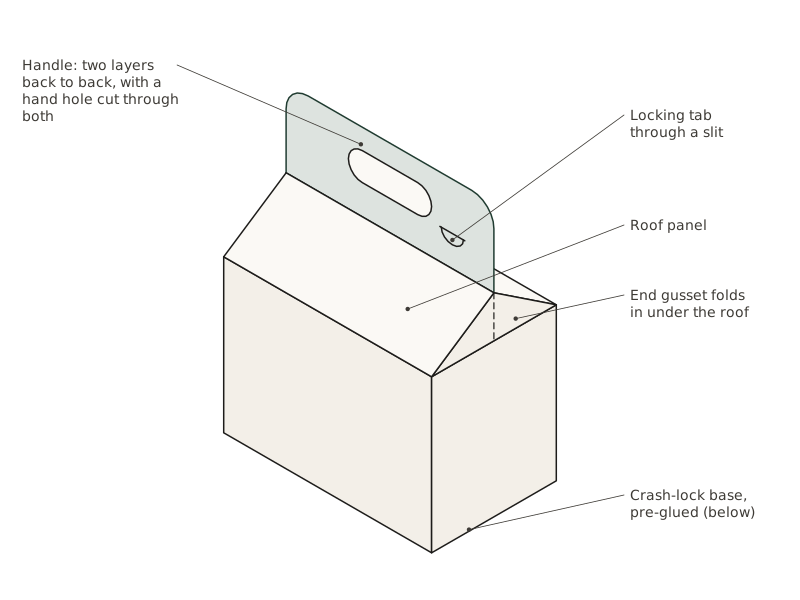
On a gable box the two long panels continue upwards and are scored to fold towards each other, forming a pitched roof. The end panels fold in as triangular gussets beneath the roof panels. At the peak each roof panel carries a handle extension; the two meet back to back, and a cut-out through both forms the hand hold.
Locking the top
The roof panels are held together by locking tabs: a tab on one handle panel pushes through a slot in the other, or the two handle panels interlock with a hook and slot. This keeps the top closed while carried without any glue. For gifts, or food carry-outs that should not be opened on the way home, a sticker or seal across the handle joint adds tamper evidence.
Handle boxes: briefcase and tote styles
Other handle cartons place the handle on an extended back panel, folded double for strength, which passes through a slot in the lid; or they add a separate handle of rope, ribbon or card threaded through punched holes. A handle cut from two layers of board is much stronger than one, and a reinforcing strip around the hand hold reduces tearing.
Load limits
The handle, not the base, is usually the weak point. As a working guide, a gable box in 350–400 gsm boxboard with a double-layer handle carries around a kilogram of contents comfortably; heavier packs move to micro-flute board or a separate rope handle. The real limit depends on size, board and how the contents sit, so tell us the weight and we will specify to it.
Opening and closing
How it opens and closes
Opening
The customer pulls the two handle panels apart, which releases the locking tab, and the roof panels fold back to open the top. On briefcase-style handle boxes the handle is freed from its slot and the lid lifts. The opening is at the top, so the contents are lifted out rather than slid, which suits cakes, jars and gift items.
Closing
The end gussets fold in, the two roof panels come up and meet, and the handle tabs interlock. The base is already locked from when the carton was squared open. If the box must stay closed on the way home or at a counter, add a sticker or branded label across the handle joint.
Best for
Where gable and handle boxes work best
Bakery and patisserie carry-outs
Cakes, pastries and cookies taken home by hand; tell us if the food will touch the board so the board and inks can be specified for it.
Party and event packs
Party bags, event favours and goody boxes handed to guests.
Gift and hamper packs
Small hampers, gift sets and seasonal promotions that are carried rather than posted.
Retail carry-outs
Garden centre, toy and homeware purchases carried from the counter without a separate bag.
Promotional and sample kits
Trade show and product launch kits handed out on a stand.
Candle and home fragrance gifts
A candle and matches or a diffuser set in a carry box with a board insert.
Advantages and limitations
Strengths, and where it falls short
Advantages
- A built-in handle, so no separate carrier bag is needed.
- The crash-lock base gives a firm floor that forms in one movement.
- Ships flat, with the base already glued.
- The sloping roof panels are extra printed space that is seen when the box is carried.
- Closes without glue using interlocking handle tabs.
Limitations
- The handle limits the weight; heavy packs need heavier board, micro-flute or a separate handle.
- The peaked top prevents stacking, so filled boxes take more shelf and storage space.
- The end gussets leave small openings at the top corners, so small or loose items should be wrapped.
- A more complex blank than a tuck end, so it uses more board per carton.
- Not a transit box: filled gable boxes need an outer carton for courier delivery.
Materials, printing and finishes
What it is made from and how it is decorated
Materials
Folding boxboard (FBB)
350–400 gsm for most gable boxes, giving a stiff roof and a handle that holds its shape.
Kraft board
The classic bakery and deli look; long fibres make kraft strong for handles.
Solid bleached board (SBS)
Bright white inside and out for premium gift and party packs.
Micro-flute corrugated
E flute or finer with a printed liner, for heavier packs and larger boxes.
Printing
Gable and handle boxes are printed by litho or digital in CMYK, with Pantone spot colours for exact brand colours. The roof panels and handle are prominent when carried, so they carry the brand mark; the gussets and base carry less. The inside can be printed, which is seen when the top opens. Artwork is set on our dieline with 3 mm bleed and kept clear of the handle cut-out and locking slots.
Finishes
Matt, gloss or soft-touch lamination
Protects the print and helps the handle resist scuffing and tearing. Lamination is free on every order.
Window patching
A window in the roof or front panel so the cake, gift or product is seen without opening the box.
Foil blocking
A foil logo on the roof panel for gift and seasonal packs.
Spot UV
Gloss detail on the brand mark over a matt laminated surface.
Embossing and debossing
Raised or recessed branding on the front or roof panel, away from the handle and gusset scores.
Inserts, shipping and packing
Practicalities
Inserts
A board insert with cut-outs holds cupcakes, jars or bottles upright and apart, and stops them sliding towards one end when the box is carried at an angle. A platform can lift a single item to show through a window. Inserts are made in board, corrugated or moulded pulp. Tell us what goes inside and how heavy it is, and we will size the box and insert together.
Shipping
Gable and handle boxes are delivered flat, with the side seam and crash-lock base already glued, in bundles inside corrugated courier cartons. Delivery is included on every order. Your quotation confirms the delivery address and timing. Because the filled box has a peaked top, allow for that when planning counter or storage space.
Packing and assembly
Gable boxes are packed by hand. The carton is squared so the crash-lock base drops into place, the contents go in, and the top is closed by folding the gussets and interlocking the handle. Packers are quick after the first few, which makes the style well suited to counter service where boxes are made up as orders come in.
Alternatives
When another style does the job better
Box style
Crash-lock Bottom Boxes
The same base with a tuck top, for products that sit on a shelf rather than being carried.
Compare this styleBox style
Pillow Boxes
For small, light gifts and favours where a handle is not needed.
Compare this styleBox style
Roll-End Tuck Front Mailer Boxes
When the pack will be posted rather than carried, a corrugated mailer protects it in transit.
Compare this style
- Contents, their dimensions and total weight.
- Handle style: gable top, briefcase handle, or separate rope or ribbon handle.
- Quantity, from 50 boxes.
- Board: folding boxboard, kraft, SBS or micro-flute.
- Print, finishes and any window.
- Whether food will touch the board directly.
- Insert requirements, and your required delivery date.
Gable and Handle Boxes questions
Questions buyers ask
Anything not covered here, put it in the notes on your quote and we will answer it directly.
Ask on your quoteWhat is the difference between a gable box and a handle box?
A gable box has a pitched roof formed by two top panels that meet at a central handle. Handle box is the broader term for any carry carton, including briefcase styles with a handle on an extended back panel and boxes with separate rope or ribbon handles.
How much weight can the handle carry?
In 350–400 gsm boxboard with a double-layer handle, around a kilogram of contents is a comfortable working figure. The limit depends on size and how the weight sits, so heavier packs move to micro-flute board or a separate handle.
Can gable boxes be used for food?
Many bakery and snack carry-outs use gable boxes. Tell us what the food is and whether it will be wrapped or touch the board directly, so the board and inks can be specified for that use.
Do the boxes arrive assembled?
They arrive flat with the side seam and crash-lock base already glued. Square the carton, load it and close the top; no glue or tape is needed.
Can I have a rope or ribbon handle instead?
Yes. Holes or slots are cut in the same pass as the carton, and a rope, ribbon or card handle is threaded through them. It suits heavier or more premium packs.
Can a gable box have a window?
Yes. A window in the roof or front panel, open or patched with clear film, shows the contents while keeping the handle area intact.
What is the minimum order?
The minimum order for gable and handle boxes is 50 boxes. Free Shipping, Free Lamination and No Die Charges are standard on every order.
Ready to specify your packaging?
Our team replies during business hours, 10:00–18:00 UK time.