Boxes by style: rigid
Custom drawer boxes
A drawer box is a tray that slides in and out of a separate sleeve, like a matchbox. In rigid form both parts are wrapped greyboard, so the box feels solid, opens with a smooth pull and is often kept for storage. This guide explains the sleeve and tray construction, pull options, fit, finishes and inserts, and exactly what to specify. Orders start at 50 boxes.
- Family
- Rigid
- Minimum order
- 50 boxes
- Sizing
- Made to your dimensions

Construction
How it is built
The sleeve
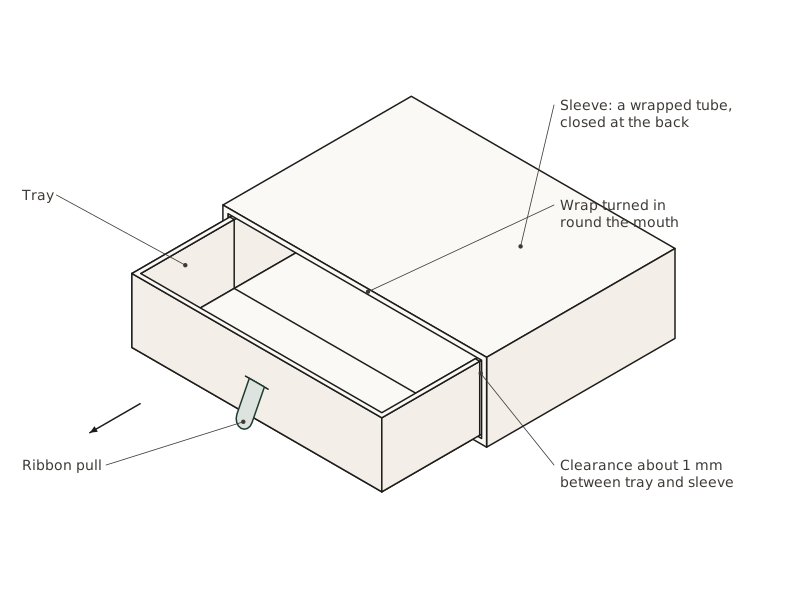
The sleeve is a four-sided greyboard tube, open at one end or at both. Its panels are cut and V-grooved or scored, formed round, and joined along one edge; the wrap covers the outside and is turned in at each open end, so no raw board shows at the mouth. On a single-ended drawer the back is closed by a fifth panel, which gives the tray a firm stop when it is pushed home.
The tray
The tray is built like the base of any rigid box: a greyboard panel and four walls, corners stayed with tape, wrapped and lined. Its external size is the sleeve's internal size less a small clearance, usually around a millimetre across the width and height, so it slides without rattling. The tray front shows in the sleeve opening, so it is often wrapped in a contrasting colour or carries a small logo.
Pulls
The customer needs something to pull. The options are a ribbon loop glued under the tray base or threaded through a slot in the tray front; a die-cut thumb notch in the sleeve edge that exposes the tray front; a finger hole or half-moon cut in the tray front itself; or a tab fixed to the tray front. A sleeve open at both ends lets the tray be pushed out from either side, so a thumb notch at each end works well.
Fit and friction
How smoothly the drawer runs depends on the clearance and on the surfaces that rub. Gloss and matt laminations slide easily; soft-touch lamination and uncoated papers grip, so we allow a little more clearance for them. A slightly firmer fit keeps the drawer from sliding open when the box is tipped, at the cost of a firmer pull, and we balance the two from your product weight and finish.
Variants
The same principle scales up to multi-drawer boxes, where two or more trays sit in one outer case like a small chest of drawers, and down to folding boxboard drawers, where the sleeve and tray are made from lighter printed board that is delivered flat. The folding carton version is covered under sleeve and slipcase boxes; this guide deals with the rigid construction.
Opening and closing
How it opens and closes
Opening
Hold the sleeve in one hand and pull the ribbon, tab or tray front with the other, and the tray slides out horizontally, revealing the contents gradually from front to back. On a sleeve open at both ends the tray can be pushed out from either end. The tray can come right out and be used as a presentation tray, unless a ribbon stay joining tray and sleeve is specified to limit its travel.
Closing
Push the tray back into the sleeve until its front sits flush with the sleeve mouth, or against the closed back on a single-ended drawer. Friction alone holds it: there are no tabs or magnets in a standard drawer box. Because a drawer can slide open if the box is tipped, boxes that travel are held with a band, a seal across the sleeve edge or a firmer fit, and packed in an outer carton.
Best for
Where drawer boxes work best
Jewellery and watches
Small drawers with a lined platform or ring slot, where a ribbon pull makes a slow, deliberate reveal.
Chocolates and confectionery
Shallow drawers with a divided tray that opens and recloses easily between servings.
Candles and home fragrance
A single jar or a set in a board cradle, with the sleeve carrying the branding all round.
Stationery and small accessories
Pens, cards and accessories in a box that goes on to be used for storage on a desk.
Gift and launch kits
Several items revealed in order as the tray slides out, with a message printed on the tray floor.
Tea and coffee assortments
Sachets or small tins in a divided drawer that is reclosed after each use.
Advantages and limitations
Strengths, and where it falls short
Advantages
- The reveal is gradual and controlled, which suits premium and gifting products.
- Reclosable and hard-wearing, so the box is often kept and reused for storage.
- The sleeve gives an uninterrupted printing surface on all four sides, with no hinge or lid line.
- Sleeve and tray can be finished differently, for example a printed sleeve over a solid-colour tray.
- Easy to open with one hand holding the sleeve, which suits products used repeatedly, such as chocolates or tea.
Limitations
- Supplied assembled and cannot be flattened, so storage and freight volume are high.
- Friction is the only closure in the standard design, so the drawer can slide out if the box is tipped unless it is banded or sealed.
- The fit is sensitive to board, wrap and lamination; soft-touch in particular adds grip and needs allowing for in the clearance.
- Heavy or very deep contents make the tray hard to slide and strain the pull, so a lid and base or magnetic box suits them better.
- Two wrapped parts plus a pull make it slower to produce than a folding carton, and more expensive per unit.
Materials, printing and finishes
What it is made from and how it is decorated
Materials
Greyboard (chipboard)
Typically 1.5–2 mm for small drawers and 2–3 mm for larger or heavier ones; the sleeve and tray can use different gauges.
Printed art paper wrap
Coated paper printed in CMYK or Pantone and laminated, the standard for a fully printed sleeve.
Speciality papers
Textured, linen-finish and coloured-through papers, often used on the tray to contrast with a printed sleeve.
Ribbon
Satin or grosgrain ribbon for the pull, matched to the wrap colour and fixed under the tray or through its front wall.
Folding boxboard (carton drawers)
Where a lighter, flat-packed drawer is enough, the sleeve and tray can be made from folding boxboard instead of greyboard.
Printing
The sleeve is the main printed surface. It is wrapped as one piece round four sides, so artwork runs continuously across the join and must allow for the turn-ins at the open ends; our dieline shows where the join falls. The tray front shows in the sleeve mouth and is usually a solid colour or carries a small logo. The tray floor and inner walls are printed on the liner, a good place for a message revealed as the drawer opens. Litho suits most runs, giving accurate colour on coated paper, and digital print suits very short runs and versions.
Finishes
Soft-touch lamination
A velvety sleeve surface. It adds friction where the tray meets the sleeve, so the clearance is set to suit it.
Matt or gloss lamination
Protects the sleeve mouth and edges, where hands grip; lamination is included as standard.
Foil blocking
Applied to the sleeve top, and sometimes to the tray front, before wrapping.
Embossing and debossing
A debossed logo on the sleeve top holds well in dense greyboard; embossing is kept shallow so it survives wrapping.
Spot UV
Gloss detail on the sleeve, most effective over matt or soft-touch lamination.
Inserts, shipping and packing
Practicalities
Inserts
The tray usually carries an insert that keeps the product still as the drawer moves: wrapped board platforms, slotted card for rings and cards, divided trays for chocolates or tea, or EVA cut to the product outline for glass and watches. Because the tray slides, anything loose shifts to the back when the drawer is pulled, so a fitted insert matters more here than in a lid and base box. Allow for the insert height inside the tray depth when you give dimensions.
Shipping
Rigid drawer boxes are delivered assembled, packed in outer cartons, and cannot be folded flat, so allow for their storage volume. If flat delivery matters more than rigidity, a folding boxboard sleeve and tray is the lighter alternative. To send drawer boxes on to customers, band or seal the drawer and pack each box in an outer courier carton. Delivery is included on every order. Your quotation confirms the delivery address and timing.
Packing and assembly
Packing is by hand: slide the tray out, load the insert and product, and push it home. It is quick, but each box needs both hands and the tray has to be lined up with the sleeve, so it is a little slower per box than dropping a lid on. If boxes are packed and stored before dispatch, a band or seal stops trays sliding out when cartons are moved.
Alternatives
When another style does the job better
Box style
Sleeve and slipcase boxes
A printed board sleeve over a carton or tray, lighter and delivered flat. Choose it for retail volumes where a slide-out reveal is wanted at a lower unit cost.
Compare this styleBox style
Magnetic closure boxes
Choose it when the whole interior should be revealed at once on a hinge, or when the contents are too heavy to slide comfortably.
Compare this styleBox style
Lid and base boxes
Choose it for deep or bulky contents that are easier to lift out from above than to slide out from the side.
Compare this style
- Internal dimensions of the tray (length × width × depth), and which end the drawer should open from.
- Sleeve open at one end or at both.
- Pull: ribbon (and its colour), thumb notch, finger hole or tab.
- Wrap for sleeve and tray, and whether they differ in colour or paper.
- Printing on the sleeve, the tray front and the tray liner, in CMYK or Pantone.
- Finishes and positions: lamination type, foil blocking, embossing or debossing, spot UV.
- Insert layout, the item each cavity holds, and the weight of the contents.
- Quantity (from 50 boxes) and your required delivery date.
Finished work
Drawer boxes we have made
Drawer boxes 
Drawer boxes 
Drawer boxes
Drawer boxes questions
Questions buyers ask
Anything not covered here, put it in the notes on your quote and we will answer it directly.
Ask on your quoteWhat is a drawer box?
A drawer box is a two-part box: a tray that slides in and out of a sleeve, like a matchbox. Our rigid drawer boxes are made from wrapped greyboard, arrive assembled and open with a ribbon, tab or thumb notch.
What is the difference between a drawer box and a sleeve box?
In a drawer box, the tray and sleeve are made to fit each other as one pack and the tray slides out to open it. A sleeve box or slipcase usually means a printed band or cover slid over a separate box. The two overlap, and we will advise which suits your product.
How does the customer open a drawer box?
By pulling a ribbon loop, a tab or the tray front through a thumb notch in the sleeve. On a sleeve open at both ends, the tray can also be pushed out from the opposite end.
Will the drawer slide open on its own?
A well-fitted drawer stays closed in normal handling, but it can slide if the box is tipped or shaken. For posting or display, add a band or seal, or ask for a slightly firmer fit.
Can drawer boxes be delivered flat?
Rigid drawer boxes cannot be flattened. If flat delivery is essential, a folding boxboard sleeve and tray, or a collapsible rigid box, are the alternatives.
Can you print inside the drawer?
Yes. The tray floor and walls are covered with a liner that can be printed with a message, pattern or instructions, revealed as the drawer opens.
What is the minimum order for drawer boxes?
The minimum order is 50 boxes. Your quotation can show two or three quantities so you can compare the unit cost.
How long do drawer boxes take to make?
Two wrapped parts, a pull and any finishes all take time, and rigid boxes are assembled partly by hand. Tell us your required delivery date and our team will confirm whether the timing is achievable.
Ready to specify your packaging?
Our team replies during business hours, 10:00–18:00 UK time.