Boxes by style: corrugated
Custom corrugated lid and base boxes
A corrugated lid and base box is a two-piece box made from printed corrugated board: a base tray and a separate lid that fits over it. It gives the lift-off opening of a rigid gift box with the lighter weight, strength and, in most versions, flat delivery of corrugated. This guide covers tray constructions, board, print, uses, limits and what to specify. Orders start at 50 boxes.
- Family
- Corrugated
- Minimum order
- 50 boxes
- Sizing
- Made to your dimensions
Construction
How it is built
Two trays, one telescope box
The base and the lid are each a die-cut corrugated tray. The lid is sized to the base's external dimensions plus a clearance for the board thickness, which is larger than on a rigid box because corrugated is thicker and more compressible, typically a few millimetres. The lid can be as deep as the base, a full telescope and the strongest form, or shallower, a partial telescope that shows part of the base. FEFCO's telescope-type styles, the 03 series, describe the standard layouts.
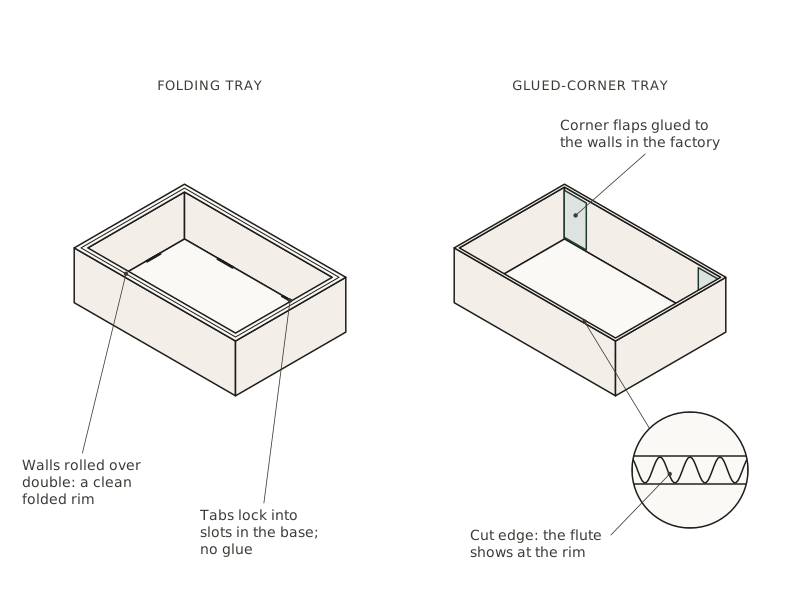
Folding trays
A folding tray has double walls that roll over at the top, like the ends of a mailer box, with corner ears trapped inside and tabs that lock into slots in the base. It needs no glue, is delivered flat and is formed by hand at packing. The rolled walls give a clean top edge with no cut flute showing, which matters on the lid rim and the base edge customers see.
Glued-corner trays
A glued-corner tray has corner flaps glued to the walls during manufacture, so it is ready to use on arrival and needs no forming. It is delivered as assembled trays, which take more storage space. Single-wall glued trays show the board's cut edge at the rim, which suits kraft designs but looks less finished on full-colour print unless the edge is folded over.
Board grade
E flute, roughly 1.5 mm, suits lighter contents and gives the best print surface; B flute, roughly 3 mm, is used for general-purpose and heavier boxes; E/B double wall is used for hampers, bottles and heavy sets. Calipers vary by mill. The lid and base are normally the same grade, and we recommend it from the contents and their weight.
Opening and closing
How it opens and closes
Opening
Lift the lid straight up off the base. Because the clearance is a little larger than on a rigid box, the lid lifts off easily and seldom needs thumb notches, though they can be die-cut into the base walls of deep boxes. The whole top of the box is then open, so the contents are seen from above and lifted out, which is the gift-box moment many brands want from a posted box.
Closing
Lower the lid over the base: friction and the lid's own weight hold it in place for handling and stacking. For courier and postal journeys the lid must be secured, with tape, a printed seal or band, or by packing the box inside an outer carton, because a lift-off lid will not stay on under impact by itself.
Best for
Where corrugated lid and base boxes work best
Apparel and fashion
Shallow printed boxes for garments and accessories, posted or handed over in store.
Footwear
The traditional lid and base format for shoes and boots, in E flute with a printed lid.
Hampers and food gifts
Double-wall boxes for heavier gift sets, with each item in its own pack and a divided insert.
Corporate gifts
A printed lid with a message inside, lighter and less expensive than a rigid box.
Subscription boxes
A lift-off lid gives a gift-like opening, secured with a printed seal for transit.
Reusable storage
Full-depth boxes that customers keep for storage, where stacking strength counts.
Advantages and limitations
Strengths, and where it falls short
Advantages
- Much lighter and less expensive than a rigid lid and base box of the same size, with good stacking strength.
- Folding-tray versions arrive flat and form without glue.
- A full-depth lid doubles the wall thickness all round, making a strong box that stacks well.
- Lid and base can be printed differently, including a message inside the lid.
- Scales easily to large sizes such as hampers, where rigid boxes become heavy.
Limitations
- Looks and feels like good corrugated packaging rather than a rigid presentation box; edges are softer and the surface less refined.
- A lift-off lid is not a closure: boxes that travel need tape, a seal, a band or an outer carton.
- Glued-corner trays arrive assembled and take storage space; only folding trays arrive flat.
- Fine finishes are limited on corrugated: embossing crushes the flute, and fine print detail is best on E flute.
- Two parts to form and handle make packing slightly slower than a one-piece mailer.
Materials, printing and finishes
What it is made from and how it is decorated
Materials
E flute corrugated
Roughly 1.5 mm; a smooth surface for print and neat folds, for lighter contents and print-led designs.
B flute corrugated
Roughly 3 mm; more crush resistance and cushioning, for general-purpose and heavier boxes.
E/B double wall
Two fluted layers for hampers, bottles and heavy sets, and for boxes that are stacked or reused.
White and kraft liners
White for clean full-colour print; brown kraft for a natural look with one or two colours.
Litho-laminated board
A litho-printed sheet laminated to the fluted board, for the sharpest full-colour lids.
Printing
The lid top is the main printed surface, followed by the lid walls and, on a partial-depth lid, the exposed band of the base. Full-colour designs are usually litho-laminated to E flute; flexo suits one to three spot colours direct on kraft or white liners; digital print suits short runs and full colour without plates. Inside the lid is the first surface seen after opening, so it often carries a message or pattern. Artwork is set up on our dieline for each tray, allowing for rolled walls on folding trays.
Finishes
Lamination
Matt or gloss lamination on litho-laminated lids protects the print from scuffs; lamination is included as standard, and varnish is the lighter option on direct print.
Foil blocking
A logo on a litho-laminated E flute lid, kept simple because heavy pressure crushes corrugated.
Spot UV
Gloss detail over matt lamination on the lid top.
Embossing and debossing
Not recommended on corrugated, because pressure crushes the flute; use foil blocking or spot UV for emphasis.
Inserts, shipping and packing
Practicalities
Inserts
Corrugated platforms, dividers and cut-out holders made from the same board suit most contents, keeping items in position and at a set height. Card inserts are used where the insert is printed, and EVA or foam only for fragile items. Because the lid lifts off and the contents are seen from above, a shallow insert that presents items neatly in a layout is worth specifying, especially for hampers and gift sets.
Shipping
Folding-tray versions are delivered flat; glued-corner trays are delivered assembled and packed in outer cartons. Either can travel by courier as the outer box if the lid is taped, sealed or banded, but fragile contents are safer inside an outer carton. Delivery is included on every order. Your quotation confirms the delivery address and timing.
Packing and assembly
With folding trays, form the base, load the insert and contents, form the lid and place it over the base, then seal. Glued-corner trays skip the forming step. Each box involves two parts, so it is a little slower to pack than a one-piece mailer; forming trays in batches ahead of a packing session helps. Hand packing is usual at small and medium volumes.
Alternatives
When another style does the job better
Box style
Roll-end tuck front mailer boxes
A one-piece mailer with a hinged lid that tucks shut. Choose it when speed of packing and security in the post matter more than a lift-off lid.
Compare this styleBox style
Lid and base boxes
The rigid version, heavier and more refined. Choose it when the box is a keepsake rather than a transit box.
Compare this styleBox style
Collapsible rigid boxes
Rigid presentation that still arrives flat. Choose it for gifts that justify a greyboard box and will be posted inside an outer carton.
Compare this style
- Internal dimensions of the base (length × width × depth) and the weight of the contents.
- Lid depth: full depth or partial depth.
- Tray construction: folding trays delivered flat, or glued-corner trays delivered assembled.
- Board grade, or the contents and weight so we can recommend E flute, B flute or double wall.
- Liner colour and printing on the lid, base and inside, in full colour or spot colours.
- Finishes, inserts and any seal or band you want printed.
- Quantity (from 50 boxes), your required delivery date, and whether the boxes will be posted.
Corrugated lid and base boxes questions
Questions buyers ask
Anything not covered here, put it in the notes on your quote and we will answer it directly.
Ask on your quoteWhat is a corrugated lid and base box?
It is a two-piece box made from corrugated board: a base tray and a separate lid tray that slides over it. It is a telescope box, like a rigid lid and base box, but lighter and more robust in transit.
How does it compare with a mailer box?
A roll-end mailer is one piece with a hinged lid that tucks shut, so it is faster to pack and more secure in the post. A corrugated lid and base box has a separate lift-off lid, which gives a more gift-like opening but needs sealing for transit.
Will the lid come off in the post?
It can, because it is held only by friction. Seal it with tape, a printed seal or a band, or pack the box inside an outer carton, before it goes into a courier or postal network.
Do corrugated lid and base boxes arrive flat?
Folding-tray versions do, and are formed by hand at packing. Glued-corner trays arrive assembled and ready to use, which saves time at packing but needs more storage space.
Which corrugated grade should I choose?
E flute for lighter contents and the best print, B flute for general-purpose and heavier boxes, and E/B double wall for hampers and heavy sets. Tell us the contents and weight and we will recommend the grade.
What is the minimum order?
The minimum order is 50 boxes. Your quotation can show several quantities so you can compare the unit cost.
How long do corrugated lid and base boxes take?
It depends on the print route, the tray construction, the quantity and proof approval. Tell us your required delivery date and our team will confirm whether the timing is achievable.
Ready to specify your packaging?
Our team replies during business hours, 10:00–18:00 UK time.