Boxes by style: rigid
Custom shoulder and neck boxes
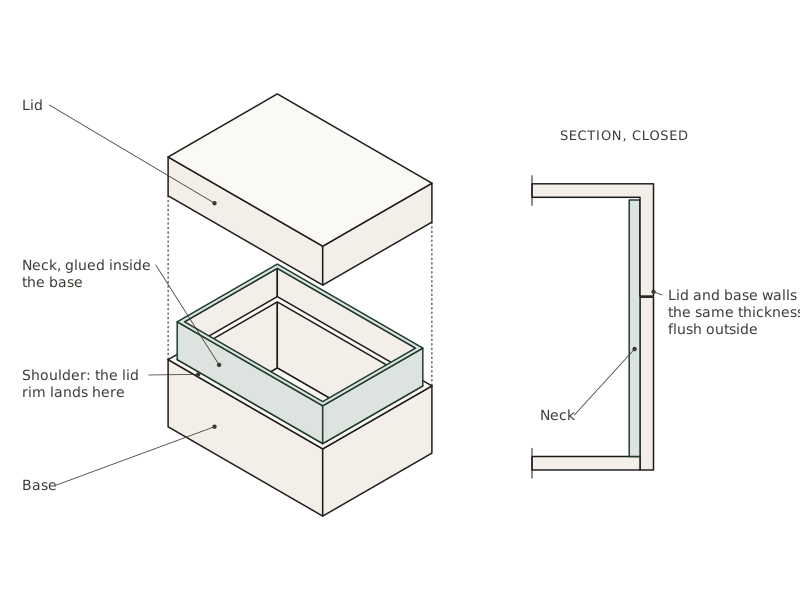
A shoulder and neck box is a three-part rigid box: a base, a neck that stands up inside it, and a lid that slides over the neck and rests on the base's top edge, the shoulder. Closed, it looks like one solid block; opened, it shows the neck, often in a contrasting colour. This guide covers construction, uses, limits, finishes and what to specify. Orders start at 50 boxes.
- Family
- Rigid
- Minimum order
- 50 boxes
- Sizing
- Made to your dimensions
Construction
How it is built
Three parts
The base is an open-topped wrapped tray, usually shorter than the finished box. The neck is a second wrapped four-wall collar or tray that fits tightly inside the base and stands above its top edge by roughly the depth of the lid. The lid is a wrapped tray sized to fit over the neck with a small clearance, and to match the base's outside footprint, so its walls line up with the base walls when closed.
The shoulder
The top edge of the base walls, around the neck, forms the shoulder. The lid slides down over the neck until its rim lands on that edge, so the outside of the closed box is flush on every side, with only a fine line where lid and base meet. Because the lid lands on a firm edge rather than on the contents, it cannot be pushed further down, and closing feels precise.
Neck forms
The neck can be a collar, four walls glued inside the base, or a full inner tray with its own floor. Its height sets how much of the box the lid covers, and it is often wrapped in a contrasting colour or paper so a band of it shows as the box opens. A variant leaves a narrow band of the neck visible even when closed, as a deliberate stripe between lid and base.
Board and tolerances
All three parts are greyboard, typically 1.5–3 mm, and the lid and base walls must be the same thickness to meet flush. Two fits are controlled at once, lid to neck and lid rim to shoulder, which is why this style needs more precise making than a lid and base box. Round shoulder boxes follow the same idea on paper tubes, which are made by a different process and quoted separately.
Opening and closing
How it opens and closes
Opening
Hold the base and lift the lid straight up: it slides off the neck with gentle resistance, revealing the neck, often in a contrasting colour, before the product itself. On tall boxes the neck guides the lid, so it comes away straight without tilting or jamming. The product is then lifted out through the neck, usually from a fitted insert or by a ribbon pull.
Closing
Lower the lid over the neck until it lands on the shoulder. The neck guides it straight down, friction on the neck walls holds it, and the flush joint with the base shows the box is fully closed. There are no magnets or tabs. As with any friction-closed box, a band or seal holds the lid for transit, and an outer carton protects the box in the post.
Best for
Where shoulder and neck boxes work best
Fragrance and perfume
A bottle held upright in a cut insert, with the neck revealed in a contrasting colour as the lid lifts.
Spirits and wine
Tall single-bottle boxes, where the neck guides a deep lid and stops it tilting.
Candles and home fragrance
Jars and diffusers in a squat box with a clean, flush exterior.
Premium skincare
A hero jar or serum presented on a raised platform inside the neck.
Watches and jewellery
Small boxes with a precise, flush closure and a lined neck.
Tea caddies and gifts
A square box kept on a shelf, with the lid lifting cleanly off the neck each time.
Advantages and limitations
Strengths, and where it falls short
Advantages
- The closed box is flush on all sides, with no step between lid and base, for a clean, architectural look.
- The neck guides the lid, so tall and deep boxes open and close straight without jamming.
- A contrasting neck adds a colour reveal on opening without any extra print.
- Double walls around the upper part of the box, lid over neck, make it especially stiff.
- No magnets or hinges to wear out, so it survives repeated opening and reuse.
Limitations
- More components and two controlled fits make it more expensive than a lid and base box, and slower to produce.
- Supplied assembled and cannot be flattened, so storage and freight volume are high.
- Friction is the only closure, so the lid needs a band or seal for transit.
- Tolerances are tight: humidity, wrap choice and lamination all affect the fit, so papers are chosen with the fit in mind.
- The neck walls take up internal space, so the usable interior is slightly smaller than the outside of the box suggests.
Materials, printing and finishes
What it is made from and how it is decorated
Materials
Greyboard (chipboard)
Typically 1.5–3 mm; lid and base walls in the same gauge so they meet flush, the neck often in a lighter gauge.
Printed art paper wrap
Coated paper printed in CMYK or Pantone and laminated, for full-colour lids and bases.
Contrasting neck paper
A coloured-through, metallic or textured paper on the neck, chosen to contrast with the outer wrap.
Speciality papers
Linen-finish, leather-look and uncoated papers for a tactile outer surface finished with foil blocking or debossing.
Liner papers
Cover the inside of the lid and neck; the lid liner can be printed with a message.
Printing
Lid and base are wrapped separately, so any design that runs across the joint must be registered on both parts; our dieline shows exactly where the lid meets the base. Continuous designs across the join are possible, but any slight misalignment shows, so many designs keep a solid colour at the joint. The neck is usually a solid paper colour rather than printed. Inside print goes on the lid liner and the neck interior. Litho gives accurate colour; digital print suits very short runs.
Finishes
Lamination
Matt, gloss or soft-touch on the lid and base; lamination on the neck adds thickness, which is allowed for in the fit. Included as standard.
Foil blocking
On the lid top and walls; a foil band around the neck is a common detail.
Embossing and debossing
A debossed logo on the lid top holds well in greyboard; embossing is kept shallow so it survives wrapping.
Spot UV
Gloss highlights over matt or soft-touch lamination on the lid.
Inserts, shipping and packing
Practicalities
Inserts
Shoulder and neck boxes usually hold one hero product, so the insert is typically a wrapped board platform or collar that holds a bottle, jar or candle centrally, or EVA cut to the outline for glass. Tall bottles are best held at the base and again near the top so they cannot rock. The insert sits inside the neck, so the neck's internal size, not the base's, is the dimension that matters when you give sizes.
Shipping
Shoulder and neck boxes are delivered assembled, usually with lids fitted, in outer cartons. They cannot be flattened, so plan for storage space. To send them on to customers, band or seal the lid and pack each box in an outer courier carton; glass contents need an insert that holds them in every direction. Delivery is included on every order. Your quotation confirms the delivery address and timing.
Packing and assembly
Packing is by hand: lift the lid, place the product in the insert inside the neck, and replace the lid. It is quick per box, although tall boxes need bench space and are best packed upright so bottles settle into their inserts. If packed boxes are stored before dispatch, a band or seal keeps the lids in place.
Alternatives
When another style does the job better
Box style
Lid and base boxes
The same two-piece principle without the neck, less expensive and quicker to make. Choose it where a flush joint and colour reveal are not needed.
Compare this styleBox style
Magnetic closure boxes
Choose it when the lid should stay attached on a hinge, or for shallow boxes where a neck adds little.
Compare this styleBox style
Crash-lock bottom boxes
A printed folding carton with a crash-lock base carries a bottle at retail volumes and arrives flat. Choose it when unit cost and storage matter more than rigid presentation.
Compare this style
- Internal dimensions of the space the product needs inside the neck, plus the weight of the product.
- Proportions: how deep the lid should be, and whether the neck is hidden or shows as a band when closed.
- Wraps for lid, base and neck, including the contrast colour or paper for the neck.
- Printing, including any design that crosses the joint between lid and base.
- Finishes and their positions: lamination, foil blocking, debossing, spot UV.
- Insert type and how the product should sit.
- Quantity (from 50 boxes) and your required delivery date.
Shoulder and neck boxes questions
Questions buyers ask
Anything not covered here, put it in the notes on your quote and we will answer it directly.
Ask on your quoteWhat is a shoulder and neck box?
It is a rigid box made of three wrapped parts: a base, a neck glued inside it that stands above its rim, and a lid that slides over the neck and rests on the base's top edge, the shoulder. Lid and base meet flush when closed.
How is a shoulder box different from a lid and base box?
A lid and base box has two parts, and the lid simply covers the base. A shoulder box adds a neck, so the lid sits on the base's edge rather than over it, giving a flush outside, a guided lid and a colour reveal on opening.
Why is the neck often a different colour?
Because it is only seen when the box opens. A contrasting or metallic neck paper gives a flash of colour as the lid lifts, without printing anything extra.
Which products suit shoulder and neck boxes?
Single hero products that deserve a precise, solid box: fragrance, spirits, candles, diffusers, premium skincare and watches. Tall boxes benefit most, because the neck guides the lid.
Can shoulder and neck boxes be round?
The same lid, neck and base principle is used on round paper tubes, but they are made by a different process from square greyboard boxes. Ask if you need a round pack and we will advise.
What is the minimum order for shoulder and neck boxes?
The minimum order is 50 boxes. Your quotation can show several quantities so you can compare the unit cost.
How long do shoulder and neck boxes take?
Three wrapped parts and two precise fits take longer than a two-piece box, and finishes add a step. Tell us your required delivery date and our team will confirm whether the timing is achievable.
Ready to specify your packaging?
Our team replies during business hours, 10:00–18:00 UK time.