Boxes by style: rigid
Custom magnetic closure boxes
A magnetic closure box is a rigid box whose lid is hinged along the back and whose front flap is held shut by magnets hidden under the wrap. It arrives assembled, opens in one movement and closes with a soft click. This guide explains exactly how it is built, where it works best, its honest limits and what to specify. Orders start at 50 boxes.
- Family
- Rigid
- Minimum order
- 50 boxes
- Sizing
- Made to your dimensions

Construction
How it is built
Two wrapped parts, one box
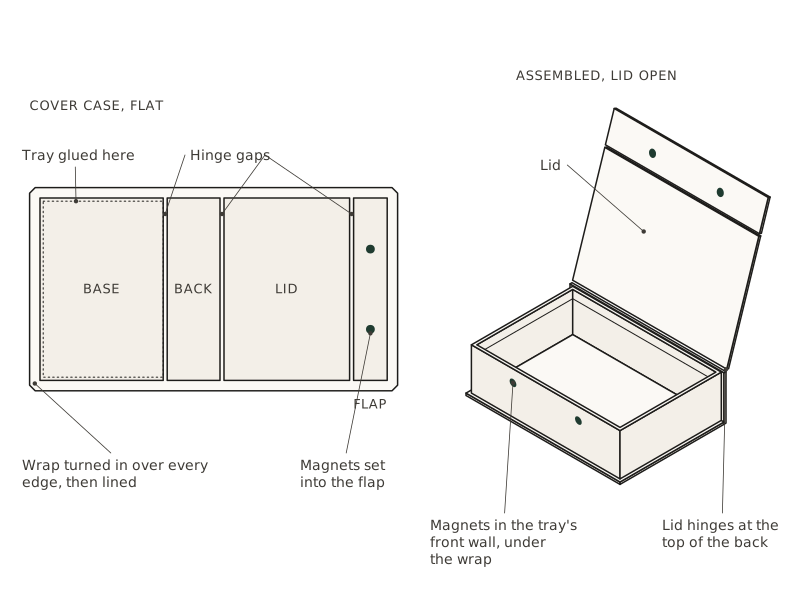
The box is made from two assemblies. The tray is greyboard cut to a base and four walls, V-grooved or scored at the corners, folded up, held with corner stay tape and then wrapped. The cover is a separate flat case: a back panel, a lid panel and a front flap panel cut from greyboard and laid on one sheet of wrap with small gaps between them. The tray is glued into the cover along its back wall and base, so cover and tray become a single box.
Hinges without hardware
There are no mechanical hinges. Each hinge is the gap between two boards in the cover, bridged by the wrap on the outside and the liner paper on the inside. The gap is set to the board thickness plus a little clearance, so the lid folds through its full travel without the wrap splitting at the fold. For heavy lids, or boxes that will be opened many times, a cloth hinge strip can be added under the wrap.
Magnets set into the board
Small disc magnets, usually neodymium, are set into pockets cut in the front flap board, with matching magnets or thin steel plates set into the front wall of the tray. The wrap and liner cover them completely, so nothing shows. Magnet size, number and spacing are chosen for the width of the flap and the weight of the lid: one pair suits a small box, while a wide lid needs two or more pairs so its corners do not lift.
Wrap, turn-ins and overhang
The printed or speciality wrap is glued to the board and turned in over every raw edge, typically by 10–20 mm, and the inside is then covered with a liner paper that hides the turn-ins. The cover boards are cut a few millimetres larger than the tray on each side, giving a small, even overhang that frames the closed box and protects the tray edges. V-grooved corners read almost sharp; scored corners are slightly rounded.
Board gauge
Greyboard is typically 1.5–3 mm thick. Around 1.5–2 mm suits small boxes and light contents; 2.5–3 mm is used for large lids, bottles and devices, where a thinner board would flex. The cover and tray can be different gauges, and exact gauges vary slightly between board suppliers, so we specify the board from your product weight rather than asking you to choose.
Opening and closing
How it opens and closes
Opening
Lift the front flap with a thumb, against the pull of the magnets, and the lid swings up and back on the hinge at the top of the back wall. Most boxes open to around ninety degrees and rest there, or fall back past it onto the table. If the lid should stop at a set angle, ribbon stays are glued between lid and tray. The whole interior and insert are shown at once, which is why this style is chosen for presentation.
Closing
Lower the lid and the front flap drops over the front wall; the magnets pull the last few millimetres and hold the flap flat. There are no tabs, tucks or ties, so the box can be opened and closed repeatedly without wear. The magnets hold the lid in normal handling, but they are not a transit seal: in the post, a belly band, a seal or an outer carton stops the lid opening under impact.
Best for
Where magnetic closure boxes work best
Cosmetics and skincare gift sets
Several products shown together in a card or EVA insert, all revealed at once when the lid swings back.
Corporate and client gifts
A box that is kept and reused, with the logo foil blocked on the lid and a message printed inside.
Electronics and accessories
A device held in a fitted cradle with a separate cavity for cables, in a box as solid as the product.
Jewellery and watches
Small boxes with a lined platform, where the magnetic click is part of the presentation.
Fragrance and spirits
A bottle held in a cut EVA or wrapped board insert, with a heavier greyboard gauge to carry the weight.
Launches and press kits
Short runs where presentation matters more than unit cost, starting from 50 boxes.
Advantages and limitations
Strengths, and where it falls short
Advantages
- Opens in one movement and closes with a click, with no tabs or tucks to wear out.
- The hardware is hidden: magnets sit under the wrap and liner, leaving clean surfaces for print and finishes.
- Stiff greyboard walls protect the contents and keep their shape in the hand and on display.
- The inside of the lid is a printable surface, so a message or pattern is revealed as the box opens.
- Suited to reuse, so the box can stay in view long after the product has been used.
- Takes every rigid box finish: foil blocking, embossing, debossing, spot UV and all three laminations.
Limitations
- Costs considerably more per unit than a folding carton or mailer box, because the board is thicker and wrapping, magnet setting and assembly involve hand work.
- Supplied assembled, so it takes far more space in transit and storage than flat packaging, unless you choose the collapsible version.
- The magnets are not a transit seal: the lid can open if the box is dropped or squeezed, so posted boxes need an outer carton, band or seal.
- Magnets and EVA inserts are non-paper components, which makes the box harder to recycle; board inserts and a ribbon closure avoid them where that matters.
- Takes longer to produce than a printed carton, because wrapping and assembly are partly done by hand.
- Awkward for very deep boxes with small footprints, where a hinged lid becomes unwieldy; a lid and base or shoulder and neck box usually works better.
Materials, printing and finishes
What it is made from and how it is decorated
Materials
Greyboard (chipboard)
The structural core, typically 1.5–3 mm: lighter gauges for small boxes, 2.5–3 mm for large lids and heavy contents. Gauges vary slightly by supplier.
Printed art paper wrap
A coated paper, typically in the region of 120–170 GSM, printed in CMYK or Pantone and laminated before wrapping. The standard for full-colour artwork.
Speciality and textured papers
Linen-finish, embossed, coloured-through, uncoated and leather-look papers, chosen for feel and usually finished with foil blocking or debossing rather than full-colour print.
Liner paper
Covers the inside faces and hides the turn-ins: plain white or black, a matching colour, or printed with a pattern or message.
Magnets
Small disc magnets, usually neodymium, with matching magnets or steel plates in the tray wall, sized to the width and weight of the lid.
Printing
Wraps are printed flat before the box is made, most often by litho for accurate colour on coated paper, or digitally for very short runs and versions. The wrap is larger than the box because it includes the turn-ins and corner tabs, so artwork must be set up on our dieline rather than a simple box outline: anything near an edge wraps round it. Inside print goes on the liner, so a printed interior means a second printed sheet. Dark solid colours need care, because printed paper can show a pale line where it folds round a corner; lamination or a coloured-through paper reduces it.
Finishes
Soft-touch lamination
The most common choice on magnetic boxes: a velvety matt surface that suits the weight of the box. It shows fingerprints and scuffs more readily on dark colours.
Matt and gloss lamination
Matt gives a quiet, even surface and gloss deepens colour. Both protect the wrap at the corners and hinge, and lamination is included as standard.
Foil blocking
Gold, silver, copper, coloured or holographic foil applied with a heated die to the wrap before it goes on the board, usually on the lid and flap.
Embossing and debossing
Debossing reads well on rigid boxes because the dense board holds the impression; embossing is kept shallow so it survives wrapping.
Spot UV
A glossy, slightly raised coating on selected areas, most effective over matt or soft-touch lamination.
Inserts, shipping and packing
Practicalities
Inserts
Most magnetic boxes need an insert, because the box opens wide and whatever is inside is on show. Card or greyboard inserts wrapped in the same paper as the box make platforms, cradles and wells for cosmetics and gift sets; EVA or foam cut to the product outline suits glass, electronics and watches; corrugated inserts are used for heavy items where cost matters more than finish. Allow for the insert in the internal dimensions: we build the box around the insert, and the insert around the product.
Shipping
Standard magnetic boxes are delivered assembled and packed in outer cartons, so they take much more space in transit and storage than flat packaging; plan your storage accordingly. When you send them on to customers, pack each box in an outer courier carton or postal box, because the lid can open under impact and the wrap scuffs in a parcel network. Delivery is included on every order. Your quotation confirms the delivery address and timing.
Packing and assembly
Packing is quick and entirely by hand: place the insert and product, add any tissue or card, and close the lid, with no folding or tape. There is nothing to erect, which suits small teams and gifting campaigns, but assembled boxes need bench and shelf space before packing. Magnetic boxes are not designed for automatic packing lines; at high volumes, a printed folding carton or a collapsible box is faster to handle and store.
Alternatives
When another style does the job better
Box style
Collapsible rigid boxes
Keeps the magnetic flap lid but arrives flat. Choose it when freight and storage space matter more than the extra stiffness of a fixed box.
Compare this styleBox style
Lid and base boxes
Choose it when the lid should lift off rather than hinge, as with apparel and deep boxes, or when you want a simpler rigid construction.
Compare this styleBox style
Book-style boxes
Opens sideways like a hardback and can stand upright on a shelf. Choose it for sets, stationery and products presented like a book.
Compare this styleBox style
Roll-end tuck front mailer boxes
A printed corrugated mailer arrives flat and travels as the outer box. Choose it when the box goes through the post on its own.
Compare this style
- Internal dimensions (length × width × depth) of the space the product and insert need, plus the weight of the contents.
- Quantity, or two or three quantities to compare; orders start at 50 boxes.
- Lid style: a front flap that overlaps the front wall or a lid that meets the tray flush, and whether ribbon stays should limit the opening.
- Wrap: printed art paper or a speciality paper, and whether the liner inside is printed.
- Printing: outside, inside or both, in CMYK or Pantone.
- Finishes and where each one sits: lamination type, foil blocking, embossing or debossing, spot UV.
- Insert: material, number of cavities and what each one holds.
- Your required delivery date, and whether the boxes will be posted on to customers.
Finished work
Magnetic closure boxes we have made
Magnetic closure boxes · Greyboard 
Magnetic closure boxes · Foil blocking
Magnetic closure boxes questions
Questions buyers ask
Anything not covered here, put it in the notes on your quote and we will answer it directly.
Ask on your quoteWhat is a magnetic closure box?
It is a one-piece rigid box made from greyboard wrapped in printed or speciality paper, with a lid hinged along the back and a front flap held shut by magnets concealed under the wrap. It arrives assembled and opens in one movement.
Are magnetic closure boxes the same as book-style boxes?
The names overlap in the trade. We call a box magnetic closure when the lid hinges along the back and lifts upwards, and book-style when the cover hinges on a side spine and opens sideways like a hardback. Both can close with magnets.
Can the magnets be seen?
No. They sit in pockets in the board under the wrap and liner, so the only sign of them is the pull as the flap closes. If your product is sensitive to magnetism, such as some mechanical watches, tell us so the magnets can be placed away from it or a ribbon closure used.
Can magnetic boxes be delivered flat?
Standard magnetic boxes are supplied assembled. If flat delivery matters, the collapsible version has the same magnetic flap lid and folds flat until you assemble it at packing.
Can I post a magnetic box without an outer carton?
We do not recommend it. The magnets hold the lid in normal handling, not under impact, and the wrap will scuff in a parcel network. Use an outer carton or postal box; a band or seal is enough only for hand delivery.
What is the minimum order for magnetic closure boxes?
The minimum order is 50 boxes. Your quotation can show two or three quantities so you can see how the unit cost changes with volume.
How long do magnetic boxes take to make?
Rigid boxes take longer than printed cartons: the board is cut and wrapped, magnets are set, the boxes are assembled partly by hand, and finishes such as foil blocking add a step. Tell us your required delivery date and our team will confirm whether the timing is achievable.
Can I see a sample before the full order?
Ask about sample options when you request your quotation. Before production you approve a proof of the artwork on the dieline, so the position of every print and finish is agreed in advance.
Ready to specify your packaging?
Our team replies during business hours, 10:00–18:00 UK time.