Boxes by style: retail
Custom counter display units
A counter display unit, or CDU, is a printed board tray that stands on a shop counter or shelf, holds a quantity of your product and carries your brand on a raised header. It turns small products into a visible point-of-sale display beside the till. This guide explains how CDUs are built, the board choices, how they travel and set up, and what to specify. Orders start at 50 boxes.
- Family
- Retail
- Minimum order
- 50 boxes
- Sizing
- Made to your dimensions
Construction
How it is built
One-piece die-cut tray
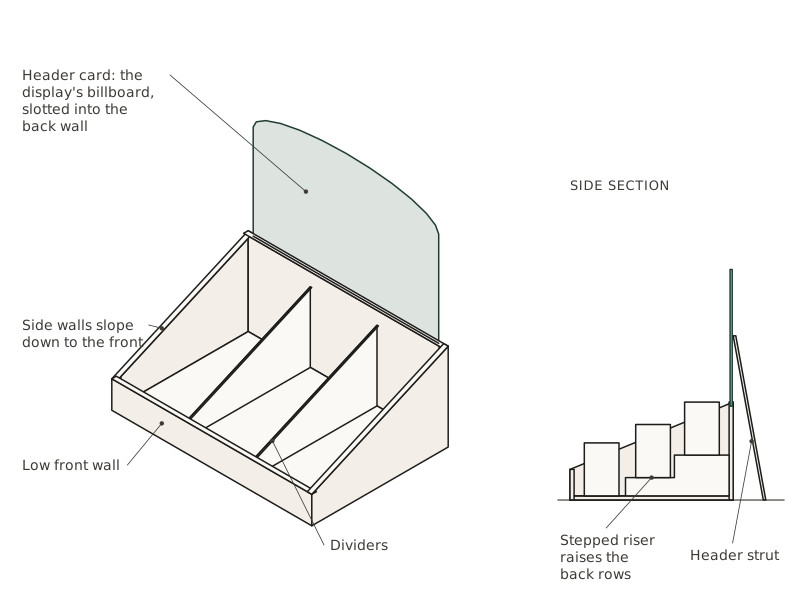
Most CDUs are a single die-cut blank folded into a tray: a base, a low front wall so customers can see and take the product, side walls that usually slope down from back to front, and a tall back wall that continues up into the header. Walls are often doubled, folded over at the top edge for strength and a clean edge, and locked with tabs into the base, so the unit needs no glue to stand up.
The header
The header is the display's billboard. It can be part of the back wall, folded up and locked in place, or a separate printed card that slots into the back wall, which lets you change the message without replacing the tray. Shaped headers are possible; wide or tall headers are braced by folded return flaps or a support strut so they do not lean forward over the product.
Base, dividers and risers
The base must carry the full product load without bowing. Light products sit on a single-layer base; heavier ones need a doubled base, a crash-lock base or an E flute construction. Dividers keep rows of product upright as the display empties, and a stepped insert raises the back rows so every unit can be seen from the front.
Transit conversion
Many CDUs travel packed, as a shipper-display: the filled tray is closed with a lid, a sleeve or a top panel that tears away along a perforated line in store, and the header is folded up once it is opened. Others are delivered flat to the shop and are formed and filled there. The right choice depends on who packs the product and how it reaches each shop, so we design the transit method with the tray.
Opening and closing
How it opens and closes
Opening
In use there is nothing to open: the display is open at the front and top so customers can see and take the product. Setting up is the equivalent of opening. Remove the transit lid or tear off the perforated top panel, fold up and lock the header, and place the unit on the counter. Flat-delivered units are folded into shape and filled first, then the header is raised.
Closing
A counter display unit does not close in use. For transit, the filled unit is closed by a fitted lid, a sleeve or a tear-away top, with the header folded down inside the lid or over the product. If a display will be moved between sites or events, a reusable lid rather than a tear-away panel is worth specifying at the design stage.
Best for
Where counter display units work best
Cosmetics and lip care
Lip balms, compacts and small skincare items at the till, where small purchases are decided.
Confectionery and snacks
Wrapped bars and sweets held in rows, each in its own retail packaging.
Health and supplements
Small cartons and sachets on pharmacy and health-shop counters.
Accessories and small gifts
Keyrings, cards, socks and small gifts displayed beside the till.
Candles and bath products
Mini candles, soaps and bath bombs, each in its own carton or wrap.
Tea and coffee
Sachets and small cartons in a divided display on a café or deli counter.
Advantages and limitations
Strengths, and where it falls short
Advantages
- Puts the product at the point of sale, where small items would otherwise be lost on a shelf.
- The header carries the brand and message at eye level, printed in full colour.
- Arrives flat or packed, and needs no tools to set up.
- Light and inexpensive compared with permanent displays, so it suits launches and seasonal promotions.
- Can double as the transit carton when made as a shipper-display, saving a separate inner pack.
Limitations
- A temporary display: board marks and softens with handling, so a CDU is designed for a promotion or season rather than years of use.
- Counter space is limited and controlled by the retailer, who may set size limits or ask to approve displays; check before you finalise the design.
- Load is limited by the board; heavy products or large quantities need corrugated, a doubled base or a floor-standing display instead.
- A packed display still needs an outer shipping carton for courier journeys unless it is designed as a robust shipper.
- Short runs are formed and packed by hand, which takes time; allow for the pack-out in your plan.
Materials, printing and finishes
What it is made from and how it is decorated
Materials
Folding boxboard (FBB)
Typically around 350–450 GSM for light products; takes fine print and all carton finishes.
Solid bleached board (SBS)
A bright white board with an excellent print surface, for premium cosmetics and gift displays.
E flute corrugated
Roughly 1.5 mm, litho-laminated for full-colour print; the usual choice for heavier contents and packed shipper-displays.
B flute or double wall
For heavy loads, larger units and displays that also serve as the shipping carton.
Kraft board
Kraft board or kraft-lined corrugated for a natural look with one or two colour print.
Printing
Most CDUs are printed in full colour by litho, either directly on folding boxboard or on a sheet laminated to E flute. Digital print suits short runs and regional or seasonal versions. The header and front are the key surfaces. The inside of the tray is seen as the display empties, so printing it in a brand colour or with a message keeps the display looking finished when stock runs low. Artwork is set up on our dieline, which shows the fold-overs and any separate header card.
Finishes
Lamination
Matt or gloss lamination protects the display from handling and scuffs at the till; lamination is included as standard.
Spot UV
Gloss highlights on the header over matt lamination, which catch shop lighting.
Foil blocking
A foil logo or message on the header, most effective on folding boxboard or SBS.
Embossing
Possible on folding boxboard headers for a raised logo; not used on corrugated, where pressure crushes the flute.
Inserts, shipping and packing
Practicalities
Inserts
Inserts in a CDU organise and present rather than protect. Dividers keep rows of product upright, stepped risers lift the back rows into view, and die-cut holders take items that would otherwise fall over, such as lipsticks, tubes and slim cartons. Tell us how many units the display holds and in how many rows, so the tray, insert and header are designed together around the product.
Shipping
CDUs are delivered to you flat, stacked in outer cartons, unless a packed format is agreed. If you fill them before sending them to shops, a filled display travelling by courier needs a lid or tear-away top and normally an outer shipping carton; for several shops, displays are packed a few to each outer carton. Delivery is included on every order. Your quotation confirms the delivery address and timing.
Packing and assembly
Displays are folded by hand, the header locked and the product loaded row by row; once the team knows the sequence, each unit is quick to fill. Decide early whether you, a fulfilment partner or the retailer will do the pack-out, because it shapes the design: shipper-displays suit packing before dispatch, while flat displays suit forming and filling in store.
Alternatives
When another style does the job better
Box style
Straight tuck end boxes
Individual retail cartons, optionally with a hanging tab for peg display. Choose them when the product sells from a shelf or hook rather than a counter.
Compare this styleBox style
Window boxes
A carton with a window shows the product on the shelf without a display unit. Choose it when each unit must sell on its own.
Compare this styleBox style
Crash-lock bottom boxes
A carton with a crash-lock base for heavier single products, and the base construction used in sturdier displays.
Compare this style
- The product: unit dimensions and weight, and how many units the display should hold, in how many rows.
- Where it will stand, counter or shelf, and any size limits set by the retailer.
- Board: folding boxboard, SBS or E flute, or ask us to recommend it from the product weight.
- Header: part of the back wall or a separate card, with its height and shape.
- Transit: delivered flat, or as a shipper-display with a lid or tear-away top.
- Printing on the header, front, sides and inside, and any finishes.
- Quantity (from 50 boxes) and your required delivery date.
Counter display units questions
Questions buyers ask
Anything not covered here, put it in the notes on your quote and we will answer it directly.
Ask on your quoteWhat is a counter display unit?
It is a self-standing printed board tray that sits on a shop counter or shelf, holds a quantity of product and carries the brand on a raised header. It is usually known in the trade as a CDU.
Are counter display units the same as display boxes?
Display box is a looser term that can mean any box that shows its contents, including window cartons. A counter display unit is specifically a stand-alone tray with a header, designed to sit at the point of sale.
What board should a CDU be made from?
Folding boxboard or SBS for light products and the finest print; E flute corrugated for heavier products and packed shipper-displays; B flute or double wall for heavy loads. Tell us the unit weight and quantity and we will recommend the board.
How much weight can a counter display hold?
It depends on the board, the size of the unit and the base construction. Send the unit weight and the number of units, and we will specify a board and base to carry the load without bowing.
Can a CDU double as the transit box?
Yes, as a shipper-display: the filled unit travels with a lid or a tear-away top that is removed in store. For courier journeys it usually still goes inside an outer carton unless it is built as a robust shipper.
Do shops need to approve counter displays?
Some retailers set size limits, ask to approve displays, or have their own point-of-sale guidelines. Check with each shop before you finalise the dimensions.
What is the minimum order for counter display units?
The minimum order is 50 boxes. Your quotation can show several quantities so you can compare the unit cost.
How long do counter display units take?
The time depends on the board, print, finishes and any insert, and on proof approval. Tell us your required delivery date and our team will confirm whether the timing is achievable.
Ready to specify your packaging?
Our team replies during business hours, 10:00–18:00 UK time.