Folding cartons · snap lock bottom
Snap Lock Bottom (1-2-3 Bottom) Boxes
A snap lock bottom box, also called a 1-2-3 bottom or lock bottom, is a folding carton whose base is formed by four die-cut flaps folded in sequence until they interlock. Nothing in the base is glued, so the carton is simpler to make than a crash-lock and carries more weight than a tuck bottom. It suits medium-weight products packed by hand at modest volumes, from 50 boxes.
- Family
- Folding carton
- Minimum order
- 50 boxes
- Sizing
- Made to your dimensions
Construction
How it is built
Four base flaps instead of a tuck
The body is four panels joined by a glue flap at one side seam, like any tuck end carton, and the top is normally a straight or reverse tuck. At the bottom, each body panel ends in a flap: two larger flaps on the front and back panels and two smaller flaps on the side panels. Each is die-cut to a shape designed to overlap and engage with the others.
Only the side seam is glued
Unlike a crash-lock, nothing in the base is glued during converting. The folder-gluer runs a single straight glue line on the side seam, the same as a tuck end carton. That keeps set-up simple and the converting cost close to a tuck carton, even though the blank uses a little more board to form the base flaps.
The 1-2-3 fold
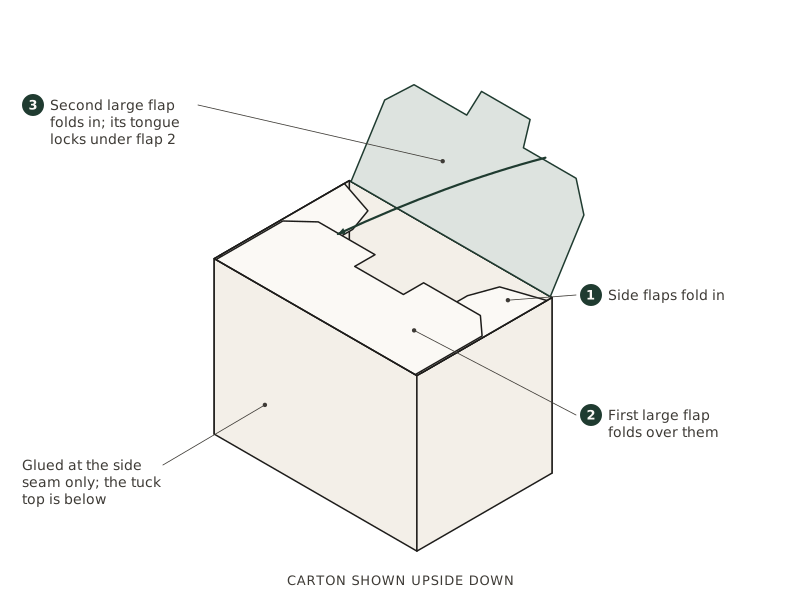
The base is closed in a set order, which is where the name comes from. First the two smaller side flaps fold in. Next one of the large flaps folds over them. Finally the opposite large flap folds in and its shaped tabs are pushed past the edges of the first, so the two large flaps lock together; a press on the centre of the floor snaps the lock home. Details vary between cutter guides, but the principle is always an interlock rather than glue.
Strength and the floor
The interlocked flaps spread the load across the base and resist being pushed open from inside, so a snap lock carries noticeably more than a tuck bottom of the same board. It is generally less strong and less consistent than a crash-lock, and the floor can have small gaps where the flaps meet. For most jars, bottles and boxed goods of moderate weight, it is more than enough.
Opening and closing
How it opens and closes
Opening
The customer opens a snap lock carton from the top, through its tuck closure: lift the tuck at the front edge, the friction locks release and the lid hinges back. The base stays locked. If the carton is to be flattened after use, the large flaps are released from each other and the base unfolds, leaving the carton undamaged.
Closing
The bottom is closed once, by the packer, using the 1-2-3 sequence before the product goes in. The top closes with dust flaps and a tuck held by friction locks, so it can be reopened as often as needed. If the top should show that it has been opened, a seal label or a seal end top can be specified.
Best for
Where snap lock bottom boxes work best
Skincare and bath jars
Glass or heavy plastic jars, bath salts and scrubs where a tuck bottom would be pushed open by the weight.
Candles and home fragrance
Moderate-weight container candles and diffusers packed by hand in launch or seasonal quantities.
Tea, coffee and dry goods
Bagged coffee, tea caddies and pouched goods, where the inner packaging keeps the contents contained above the base.
Short runs of heavier products
Launch quantities where a snap lock gives the strength you need without a crash-lock's base gluing.
Hardware and spares
Dense small parts in an inner bag, where the base must not open when the carton is lifted.
Hand-packed gift sets
Gift sets assembled at a packing table at a steady pace rather than at line speed.
Advantages and limitations
Strengths, and where it falls short
Advantages
- Stronger than a tuck bottom for jars, bottles and denser products.
- No base gluing, so converting is simpler and usually cheaper than a crash-lock.
- Ships flat and needs no tape, glue or tools at the packing table.
- The base can be unfolded so the carton flattens neatly after use.
- Takes the same tops, windows, inserts and finishes as other folding cartons.
Limitations
- Slower to erect than a crash-lock: the base is folded by hand in the right order, which adds seconds per carton on a busy table.
- Not suited to high-speed automatic packing lines, which need a pre-glued or seal end base.
- Small gaps where the flaps meet mean loose powders or tiny parts should be bagged or sealed inside.
- Load capacity is below a crash-lock in the same board; for heavy glass choose a crash-lock or micro-flute board.
- Packers need a moment's training, because a base folded out of sequence will not lock properly.
Materials, printing and finishes
What it is made from and how it is decorated
Materials
Folding boxboard (FBB)
300–400 gsm is typical; the heavier end for larger footprints and jars.
Solid bleached board (SBS)
Crisp die-cut tabs and a white inside, useful where the base is seen or printed.
Kraft board
Brown or white-lined kraft for natural and food ranges; its long fibres fold and lock well.
Micro-flute corrugated
E flute or finer with a printed liner when the product is heavier than boxboard comfortably carries.
Printing
Snap lock cartons are printed like other folding cartons: litho in CMYK with Pantone spot colours for exact brand colours, or digital for short runs and multiple versions. The base flaps can carry print, which is seen when the carton is lifted, and a simple '1, 2, 3' guide can even be printed inside the flaps to help packers. Inside print is a separate pass. Artwork is set on our dieline with 3 mm bleed and kept clear of the scores.
Finishes
Matt, gloss or soft-touch lamination
Protects the print and helps the scores fold without cracking on dark colours. Lamination is free on every order.
Foil blocking
Metallic foil on a logo or product name for gift and seasonal ranges.
Spot UV
Clear gloss highlights over a matt laminated background.
Embossing and debossing
Raised or recessed detail on the front panel, away from the base tabs.
Window patching
A film-patched window on a side or front panel, positioned so it does not weaken the base-carrying panels.
Inserts, shipping and packing
Practicalities
Inserts
Heavier products benefit from an insert that keeps them off the side walls and spreads the load on the floor. A board collar around a jar, a cradle for a bottle or a simple partition for two items are the usual answers, in board, corrugated or moulded pulp. The insert also covers the small gaps in the base, which is useful for products with loose parts. We size carton and insert together.
Shipping
Snap lock cartons are delivered flat, glued at the side seam only, in bundles inside corrugated courier cartons. Delivery is included on every order. Your quotation confirms the delivery address and timing. For onward delivery to your customers, pack the filled cartons in a mailer or outer carton with suitable cushioning.
Packing and assembly
Snap lock cartons are made for hand packing. A packer squares the carton, folds the 1-2-3 base, presses it home, loads the product and closes the top. It takes a little longer than a crash-lock but needs no equipment. At a few hundred cartons a day that difference rarely matters; at thousands, a crash-lock usually pays for itself in packing time.
Alternatives
When another style does the job better
Box style
Crash-lock Bottom Boxes
A pre-glued crash-lock (auto lock) base that locks in one movement and carries more. Worth the extra unit cost when volumes or weights are high.
Compare this styleBox style
Straight Tuck End Boxes
For light products a tuck bottom is quicker to close and uses less board.
Compare this styleBox style
Reverse Tuck End Boxes
The most economical tuck carton for light products on longer runs.
Compare this style
- Product dimensions and weight, and whether it includes glass or loose parts.
- Top closure: straight tuck, reverse tuck or seal end.
- Quantity, from 50 boxes, and the number of designs.
- Board, or the product and weight so we can recommend one.
- Print and finishes, including any print on the base flaps.
- Any insert or partition needed.
- Your required delivery date.
Snap Lock Bottom Boxes questions
Questions buyers ask
Anything not covered here, put it in the notes on your quote and we will answer it directly.
Ask on your quoteWhy is it called a 1-2-3 bottom?
Because the base is closed in three steps: the two small side flaps first, then one large flap, then the opposite large flap, which locks under the first. Done in that order, the base snaps into place without glue.
Should I choose snap lock or crash-lock?
Snap lock is simpler to produce and suits smaller hand-packed runs of moderate-weight products. Crash-lock costs a little more but erects in one movement and has the stronger, more consistent floor, so it wins on volume, weight and glass.
How much weight can a snap lock bottom carry?
Clearly more than a tuck bottom and somewhat less than a crash-lock in the same board. Many jars, candles and boxed goods sit well within it; tell us the weight and footprint and we will confirm the board, or recommend a crash-lock if it is near the limit.
Is anything in the base glued?
No. Only the side seam is glued during converting. The base holds by the interlocking shape of its flaps, which also means it can be unfolded and the carton flattened after use.
Can snap lock cartons go on a packing machine?
They are designed for hand packing. Automatic lines need a base that forms without a folding sequence, which means a crash-lock or a seal end.
What is the minimum order?
The minimum order for snap lock bottom boxes is 50 boxes. Free Shipping, Free Lamination and No Die Charges are standard on every order.
What should I send for a quotation?
The product size and weight, the quantity, the board and print you have in mind, any finishes or insert, and your required delivery date. If you are unsure between snap lock and crash-lock, tell us how you pack and we will advise.
Ready to specify your packaging?
Our team replies during business hours, 10:00–18:00 UK time.