Boxes by style: mailer
Custom roll-end tuck front mailer boxes
The roll-end tuck front box is the standard mailer box: one die-cut sheet of corrugated board that folds into a box with double side walls and a hinged lid that tucks in at the front. It needs no glue or tape to form, arrives flat and is designed to travel as the outer box. This guide explains exactly how it folds, how to specify it and when another style is better. Orders start at 50 boxes.
- Family
- Mailer
- Minimum order
- 50 boxes
- Sizing
- Made to your dimensions

Construction
How it is built
One blank, no glue
The box is die-cut and creased from a single sheet of corrugated board: a central base panel, a back wall with the lid hinged from its top edge, a front wall on the opposite side, and double-length side panels at each end. Nothing is glued in manufacture, so the blank leaves the die-cutter flat and is folded into a box by the packer.
Rolled ends and ears
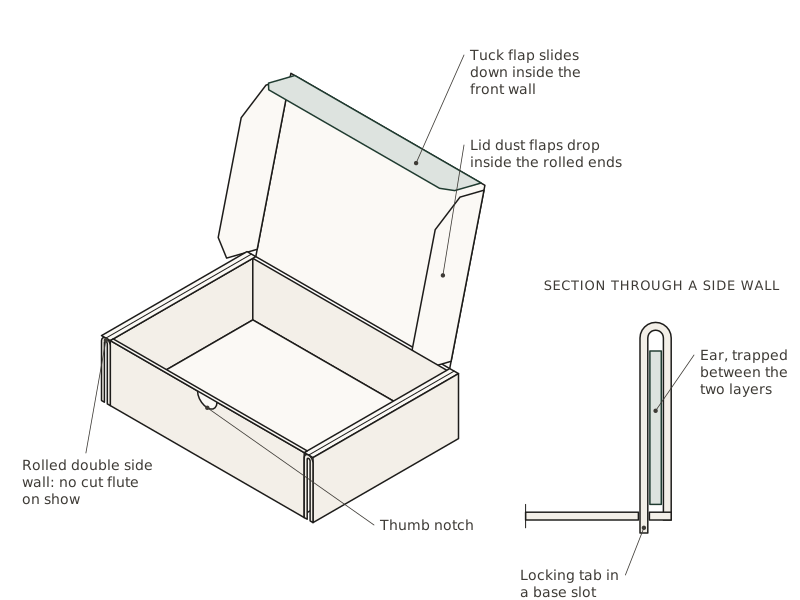
The front and back walls fold up first. Small flaps at their ends, called ears or dust flaps, fold inwards along the sides of the box. Each side panel then folds up and its inner half rolls over the top edge and down inside the box, trapping the ears between the two layers; tabs on the inner half lock into slots in the base. The result is a double-thickness side wall with a clean rolled top edge and no cut flute showing.
The lid and tuck
The lid is hinged along the top of the back wall. Dust flaps at each side of the lid fold down inside the rolled ends as it closes, and a front tuck flap slides down inside the front wall. A double front wall, where the front panel is also folded over, gives a stiffer front and a tighter tuck. A thumb notch in the front wall, locking tabs on the tuck flap (sometimes called cherry locks), and a tear strip with an adhesive closure can all be cut into the same blank.
Board grade
Most roll-end mailers are single-wall E flute, roughly 1.5 mm thick, or B flute, roughly 3 mm; exact calipers vary by mill. E flute gives a finer print surface and neater folds for lighter contents; B flute gives more crush resistance and cushioning for general e-commerce; E/B double wall is used for heavier or fragile goods. We recommend the grade once we know the contents and their weight.
Opening and closing
How it opens and closes
Opening
Lift the front edge of the lid, using the thumb notch if there is one, to draw the tuck flap out of the front wall, and the lid swings up and back on its hinge. The side dust flaps slide out of the rolled ends as it rises. The inside of the lid faces the customer as it opens, which is why it is the favourite place for inside print. If a tear strip is fitted, it is pulled first to release the adhesive closure.
Closing
Swing the lid down so its side dust flaps drop inside the rolled ends, then push the front tuck flap down inside the front wall. The tuck holds the lid shut for handling and stacking without tape. For courier and postal journeys most senders add a strip of tape or a printed seal across the front, or specify locking tabs or a tear strip with an adhesive closure, which also shows whether the box has been opened.
Best for
Where roll-end tuck front mailer boxes work best
E-commerce orders
The transit box and the branded presentation in one, sized closely to the product.
Subscription boxes
One standard size for a regular box, printed inside with a message or pattern.
Apparel and accessories
Wide, shallow boxes in E flute for folded garments, with tissue inside.
Cosmetics and bath products
Several products held in position by a corrugated or card insert.
Launch and PR kits
A full-colour mailer that makes an impression on arrival, with an insert holding each item.
Packaged food gifts
Treats and hampers where each item is already in its own retail packaging.
Advantages and limitations
Strengths, and where it falls short
Advantages
- One piece with no glue, tape or staples needed to form it, so it arrives and stores flat and folds up quickly.
- Double side walls give good crush and stacking strength for the weight of board.
- Designed to travel as the outer box, so most products need no separate shipping carton.
- Printable outside and inside, and the inside of the lid is the first thing seen on opening.
- Light compared with rigid packaging, which keeps parcel weight down.
- Easy to size closely to the product, reducing void fill and wasted space.
Limitations
- Not as stiff or refined as a rigid box; it reads as good shipping packaging rather than a keepsake box.
- The tuck closure is not tamper-evident on its own; tape, a seal or a tear strip is needed for security.
- Works best when the depth is smaller than the length and width; very deep mailers become floppy at the lid, and a different corrugated style suits them better.
- Corrugated board limits fine finishes: embossing crushes the flute, and very fine print detail is better on E flute than B flute.
- It is folded by hand at packing: quick, but still a step that a box delivered ready-made does not need.
Materials, printing and finishes
What it is made from and how it is decorated
Materials
E flute corrugated
Roughly 1.5 mm; the finest common single-wall flute, with a smooth surface for print and neat folds. Suits lighter contents and print-led designs.
B flute corrugated
Roughly 3 mm; more crush resistance and cushioning, the general-purpose mailer grade.
E/B double wall
Two fluted layers bonded together, for heavier or fragile goods and boxes that must survive repeated handling.
White and kraft liners
A white outer liner gives clean, bright colour; brown kraft suits one or two colour print and a natural look.
Litho-laminated board
A litho-printed paper sheet laminated to the fluted board, for the highest print quality and full-colour designs.
Printing
There are three routes. Litho-laminating prints the design on a paper sheet, which is then laminated to the fluted board, giving the sharpest full-colour result. Flexo prints directly on the liner and suits one to three spot colours on kraft or white board. Digital print goes directly on the board and suits short runs and full-colour designs without printing plates. Inside print is applied to the other face of the same blank, so the inside of the lid, walls and base can carry a message or pattern. Artwork is set up on our dieline, remembering that the side walls are double and the rolled inner half shows inside the box.
Finishes
Lamination
Matt or gloss lamination on litho-laminated board protects the print from scuffs in transit; lamination is included as standard, and a varnish is the lighter option on direct print.
Foil blocking
Possible on litho-laminated E flute, best kept to a logo on the lid, because heavy pressure crushes corrugated.
Spot UV
On laminated board, a gloss logo or pattern over matt lamination.
Embossing and debossing
Not recommended on corrugated, because pressure crushes the flute; foil blocking or spot UV give emphasis instead.
Inserts, shipping and packing
Practicalities
Inserts
Most roll-end mailers use corrugated inserts cut from the same board: platforms that raise a product, dividers and cut-out holders that fix items in position, and folding cradles that suspend fragile goods away from the walls. Card inserts are used where the insert is printed, and EVA or foam only for fragile or high-value items. Tell us the items per box and their sizes; the insert sets the internal dimensions, and a close fit reduces void fill.
Shipping
Roll-end mailers are delivered flat, stacked in bundles or outer cartons, so a large quantity takes little storage space. Packed, they travel as the outer box through courier and postal networks. Size the box closely to the product to reduce void fill and keep within the parcel size band you use; our guide to Royal Mail and courier sizes explains how bands work. Delivery is included on every order. Your quotation confirms the delivery address and timing.
Packing and assembly
Folding by hand is quick once packers are familiar with the sequence: fold up the front and back walls, fold in the ears, roll the ends over and lock the tabs, load the product and insert, and tuck the lid. Boxes can be folded in batches ahead of a packing session. Automatic forming of roll-end mailers needs dedicated equipment, so at small and medium volumes they are folded by hand.
Alternatives
When another style does the job better
Box style
Corrugated lid and base boxes
A separate lid and base in printed corrugated. Choose it when a lift-off lid suits the unboxing better, or for deeper contents.
Compare this styleBox style
Collapsible rigid boxes
Rigid presentation that still arrives flat. Choose it when the box is a keepsake and will be posted inside an outer carton.
Compare this styleBox style
Straight tuck end boxes
A folding carton for retail shelves, or for light products posted inside another box. Choose it when the box does not travel on its own.
Compare this style
- Internal dimensions (length × width × depth), including any insert, and the weight of the contents.
- What is inside and how fragile it is, so we can recommend E flute, B flute or double wall.
- Liner colour: white or kraft.
- Printing: outside, inside or both; full colour or spot colours.
- Features: thumb notch, locking tabs, double front wall, tear strip and adhesive closure.
- Insert: the number of items per box and their sizes.
- Quantity (from 50 boxes), your required delivery date, and how the boxes will be sent to customers.
Finished work
Roll-end tuck front mailer boxes we have made
Roll-end tuck front mailer boxes · Corrugated board
Roll-end tuck front mailer boxes questions
Questions buyers ask
Anything not covered here, put it in the notes on your quote and we will answer it directly.
Ask on your quoteWhat is a roll-end tuck front box?
It is a one-piece corrugated mailer box. The side walls roll over into double thickness and lock into the base, and the lid, hinged at the back, closes with a flap that tucks inside the front wall. It forms without glue or tape.
What does FEFCO 0427 mean?
FEFCO publishes the standard European codes for corrugated box styles, and 0427 is the code for the one-piece roll-end tuck front folder. Quoting the code is a quick way to confirm the construction; every box is still made to your own dimensions.
Do roll-end mailer boxes need tape?
Not to form or close them: the rolled ends lock into the base and the lid tucks in. For posting, a strip of tape, a seal, locking tabs or a tear strip with adhesive closure is recommended so the lid cannot be opened unnoticed.
Should my mailer be E flute or B flute?
E flute is thinner, prints more finely and suits lighter contents and print-led designs. B flute is thicker, with more crush resistance, and suits general e-commerce. Tell us the contents and weight and we will recommend the grade.
Can you print inside a mailer box?
Yes. Inside print is applied to the other face of the same blank, so the inside of the lid, walls and base can carry a message or pattern that the customer sees on opening.
Do mailer boxes arrive flat?
Yes. They are delivered flat in bundles or outer cartons and folded into shape at packing, which keeps storage space to a minimum.
What is the minimum order for mailer boxes?
The minimum order is 50 boxes. Your quotation can show several quantities so you can compare the unit cost.
How long do printed mailer boxes take?
The time depends on the print route, board and quantity, and on proof approval. Tell us your required delivery date and our team will confirm whether the timing is achievable.
Ready to specify your packaging?
Our team replies during business hours, 10:00–18:00 UK time.