Folding cartons · crash-lock (auto lock) bottom
Crash-lock (Auto Lock) Bottom Boxes
A crash-lock (auto lock) bottom box is a folding carton whose base is pre-glued during manufacture, so it drops into a flat, locked floor the moment the carton is squared open. It carries far more weight than a tuck bottom and erects in one movement, which is why it is used for jars, bottles, candles and anything packed in volume. The top is usually a tuck. Made to your dimensions from 50 boxes.
- Family
- Folding carton
- Minimum order
- 50 boxes
- Sizing
- Made to your dimensions
Construction
How it is built
A tuck end carton with a different floor
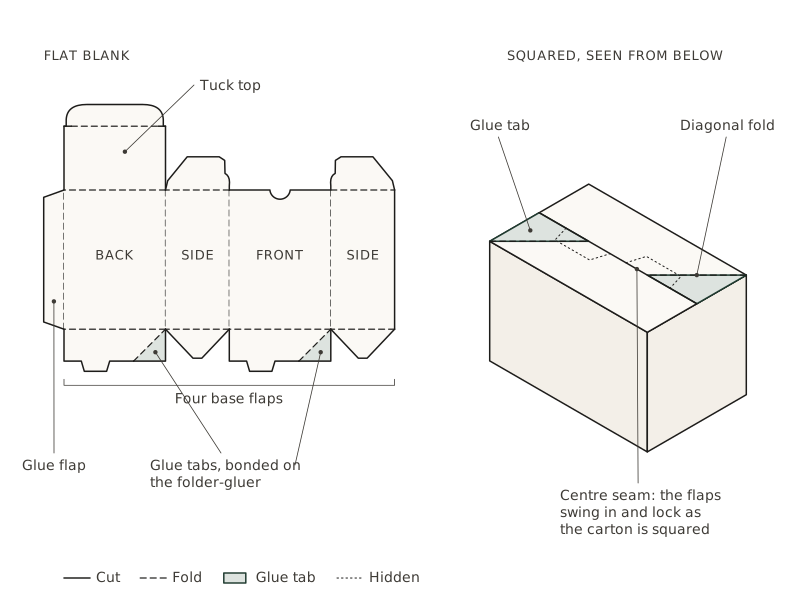
The body is the familiar four panels and glue flap, joined at one side seam. The top end is normally a straight or reverse tuck with dust flaps. The difference is the base: instead of a tuck lid, each of the four body panels ends in a base flap, and those flaps are shaped to overlap and interlock into a solid floor.
Pre-glued on the folder-gluer
The base is what gives the style its name. On a folder-gluer set up for crash-lock work, glue is applied to tabs on two of the base flaps and each is bonded to its neighbour while the carton is folded flat. The carton is delivered as a flat piece with the side seam and the base glue points already set. Those extra glue points, on top of the side seam, are why a crash-lock needs more machine set-up and more careful checking than a simple tuck end.
How the base locks
When the flat carton is squared, the glued base flaps are pulled round with the body panels. They swing into the base, overlap and push against each other until their shaped edges pass and lock. The finished floor is flat, square and double thickness over much of its area, with no hand folding at all. That is the 'crash' in crash-lock: the base crashes into place in one movement.
Load and board
Because the base flaps are bonded and overlapped rather than held by a tuck, the floor carries much more load. As a working guide, a crash-lock base in 350–400 gsm boxboard handles a filled glass jar or a bottle of around a kilogram; heavier or larger products move to micro-flute board, which takes the same base design. The real limit depends on the footprint, the board, the contents and how the carton is handled, so we size it to your product.
Board use and cost
The base flaps are larger than a tuck lid and its dust flaps, so the blank takes more board and nests less tightly on the sheet. Add the extra gluing and a crash-lock carton costs somewhat more per unit than a tuck end of the same size. Most buyers accept that for the strength of the floor and the time saved at every packing station.
Opening and closing
How it opens and closes
Opening
The customer opens a crash-lock box from the top, through the tuck closure, exactly as with a tuck end carton: lift the tuck at the front edge and the lid hinges back on the back panel. The base is not meant to be opened. When the carton is finished with, pressing the floor up from inside releases the flaps so the carton folds flat again.
Closing
The bottom closes itself when the carton is squared open, so the only closing step is the top. With a tuck top, the dust flaps fold in, the lid comes down and the tuck is held by friction locks. A crash-lock base can also be paired with a seal end top for tamper evidence, or with a gable or handle top for carry packs.
Best for
Where crash-lock bottom boxes work best
Candles in glass
Container candles and diffuser bottles that would push through a tuck bottom, held upright by a board collar or cradle.
Drinks and spirits gift cartons
Miniatures and single bottles in a carton that stays square on shelf; heavier bottles move to micro-flute board.
Skincare jars and bottles
Glass jars, droppers and pump bottles where the floor must stay flat and the packing team works quickly.
Preserves and boxed confectionery
Jars of preserves, boxed chocolates and biscuit tins, with the board specified to suit the product.
Subscription and kit packing
Large numbers of cartons erected by hand in a short time, where one movement instead of folding a base saves hours.
Hardware and household refills
Denser products such as fixings, tools and refill packs that would force open a tuck bottom.
Advantages and limitations
Strengths, and where it falls short
Advantages
- Carries far more weight than a tuck or snap lock base in the same board.
- Erects in one movement: square the carton and the floor locks, with no folding sequence to learn.
- A flat, largely double-layered floor that keeps the carton standing square on shelf.
- Still ships and stores flat, because the base glue points fold flat with the carton.
- Suits hand packing and semi-automatic erecting and top-load lines.
- Pairs with any top: straight or reverse tuck, seal end, gable or handle.
Limitations
- Costs more than a tuck end carton of the same size: more board in the blank and extra gluing.
- The base is fixed: it is not designed to be opened and reclosed like a tuck.
- There is still a limit. Above about a kilogram, or for fragile glass travelling far, specify micro-flute board or a corrugated outer.
- Relies on accurate folder-gluing; a misplaced glue point stops the base locking, so first-off cartons are checked on every run.
- Very small cartons have little room for the interlocking flaps; below a certain footprint a tuck or snap lock base is simpler.
Materials, printing and finishes
What it is made from and how it is decorated
Materials
Folding boxboard (FBB)
The standard choice at 350–400 gsm, stiff enough for a square floor and bright enough for full-colour print.
Solid bleached board (SBS)
For premium cartons, fine print and crisp foil; slightly thinner than FBB at the same weight, so the grammage is chosen to suit.
Kraft board
Natural brown board for food and candle ranges; strong for its weight, with a darker print result.
Micro-flute corrugated
E flute (around 1.5 mm) or a finer flute with a printed liner, for heavy bottles and products that need more crush resistance.
Printing
Crash-lock cartons are printed by litho for most quantities, in CMYK with Pantone spot colours where brand colours must be exact, and digitally for short runs and multiple versions. The base flaps can be printed too, since customers see the underside when they lift the carton. Barcodes and information panels usually sit on a side or back panel, clear of the glue flap and base scores. Inside print is available as a separate pass.
Finishes
Matt, gloss or soft-touch lamination
Protects print on a carton that is handled more because of its weight. Lamination is free on every order; glue areas on the base are kept clear so the bond holds.
Foil blocking
A foil logo or product name on the front panel or lid, popular on candle and spirits cartons.
Embossing and debossing
Raised or recessed branding on the front panel, well away from the base scores.
Spot UV
Clear gloss on selected areas for contrast against a matt laminated background.
Window patching
A film-patched window to show a jar or bottle, positioned so it does not weaken the panels that carry the base.
Inserts, shipping and packing
Practicalities
Inserts
Heavier contents almost always want an insert. For a jar or candle, a board collar or cradle keeps the product centred and off the side walls; for a bottle, a neck-and-base insert stops it rocking in transit. Inserts can be plain or printed board, corrugated or moulded pulp. Tell us the product's weight and shape and we will size the carton and insert together, because an insert changes the internal dimensions the base has to lock into.
Shipping
Crash-lock cartons are delivered flat, with the side seam and base already glued, bundled inside corrugated courier cartons. Delivery is included on every order. Your quotation confirms the delivery address and timing. When shipping filled cartons to customers, put them inside a mailer or outer carton; glass products also need space and cushioning around the retail carton.
Packing and assembly
Packing is where this style earns its cost. A packer picks a flat carton, squares it and the base locks: one movement, then load and close the top. On a busy table that is noticeably quicker and more consistent than folding a tuck or snap lock base. Crash-lock cartons also run on semi-automatic erectors and top-load lines, so send the machine make and size range if you have one.
Alternatives
When another style does the job better
Box style
Snap Lock Bottom Boxes
A hand-folded 1-2-3 base with no base gluing: a little cheaper to produce and still stronger than a tuck, but slower to pack.
Compare this styleBox style
Straight Tuck End Boxes
For light contents a tuck bottom is simpler, uses less board and is quick enough to pack.
Compare this styleBox style
Gable and Handle Boxes
The same crash-lock base with a carry handle top, for products taken home by hand.
Compare this styleBox style
Roll-End Tuck Front Mailer Boxes
When the box must also go through the post, a corrugated mailer protects and presents in one.
Compare this style
- Product dimensions and weight, and whether it is glass.
- Top closure: straight tuck, reverse tuck, seal end or handle.
- Quantity, from 50 boxes, and any versions.
- Board: folding boxboard, SBS, kraft or micro-flute, or ask us to recommend one for the weight.
- Print and finishes, including whether the base is printed.
- Insert type, if the product needs holding upright or apart.
- How you pack: by hand, or on an erecting or top-load machine.
- Your required delivery date.
Crash-lock Bottom Boxes questions
Questions buyers ask
Anything not covered here, put it in the notes on your quote and we will answer it directly.
Ask on your quoteIs a crash-lock box the same as an auto lock bottom box?
Yes. Crash-lock is the usual UK term; auto lock, auto-bottom and crash bottom describe the same pre-glued base that locks itself when the carton is squared open.
How much weight can a crash-lock bottom hold?
In 350–400 gsm boxboard it comfortably carries a filled glass jar or a bottle of around a kilogram. The limit depends on the footprint, board and handling; for heavier products we move to micro-flute board with the same base design.
Does the box arrive assembled?
It arrives flat, with the side seam and base glue points already set. You square it open, the base locks, and only the top needs closing.
Should I choose crash-lock or snap lock?
Choose crash-lock when cartons are packed in volume or the product is heavy or glass, because it erects in one movement and has the stronger floor. Choose snap lock for smaller runs of moderate-weight products where a slightly lower unit cost matters more than packing speed.
Can the carton be flattened after use?
Yes. Press the floor up from inside and the base flaps release, so the carton folds flat for storage or the recycling bin.
What is the minimum order for crash-lock boxes?
The minimum order is 50 boxes. Free Shipping, Free Lamination and No Die Charges are standard on every order.
How long does a crash-lock order take?
Tell us your required delivery date and our team will confirm whether the timing is achievable. The base gluing is set up and checked at the start of the run, alongside printing, finishing and cutting.
Ready to specify your packaging?
Our team replies during business hours, 10:00–18:00 UK time.