Folding cartons · seal end
Seal End Boxes and Cartons
A seal end box is a folding carton whose ends are closed by gluing overlapping flaps together rather than tucking them in. The result is a firm, square carton that shows if it has been opened, which is why seal ends are the standard format for cereals, dry goods and products filled on automatic lines. It ships flat and can include a tear strip or perforated opening. Made to your dimensions from 50 boxes.
- Family
- Folding carton
- Minimum order
- 50 boxes
- Sizing
- Made to your dimensions
Construction
How it is built
A tube with four flaps at each end
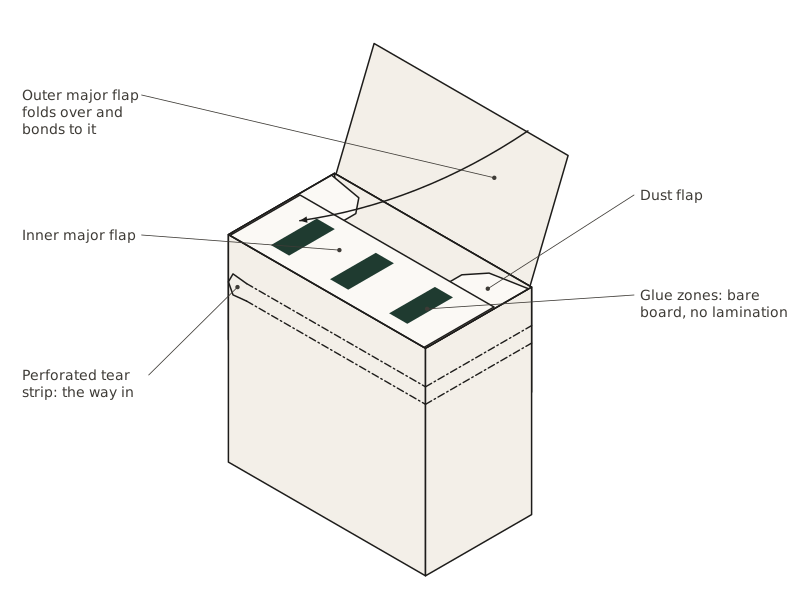
The body is four panels and a glue flap, joined at one side seam on the folder-gluer to make a flat tube. At each end every body panel carries a flap: the two on the side panels are short dust flaps (minor flaps) and the two on the front and back panels are longer major flaps. It is the same logic as a regular slotted corrugated case, scaled down to boxboard.
The glued closure
To close an end, the dust flaps fold in first and the two major flaps fold over them. Adhesive bonds the outer major flap to the inner one, or both to the dust flaps, with the major flaps either overlapping fully or meeting part-way depending on the design. On a packing line this is done with hot-melt glue in a fraction of a second; by hand it is a bead of glue or a strip of adhesive tape.
Glue-compatible surfaces
Adhesive bonds best to bare or lightly coated board, not to lamination film or heavy varnish. Where the outside of the carton is laminated or varnished, the areas that take glue are left clear, and we mark these glue-free zones on the dieline so the artwork and finish stop short of them. Getting this right is what makes a seal end hold at speed.
Planned opening features
Because the ends are glued, the carton needs a designed way in. Common options are a perforated tear strip across a panel, a tear-away panel with a thumb notch, a perforated top that becomes a reclosable tuck once opened, or a dispenser opening for tea bags and pods. The perforations are cut by the same forme as the carton and matched to the board, so they tear cleanly by hand without opening in transit.
Hybrid ends
A carton does not need seal ends at both ends. A sealed base with a tuck top gives a firm floor and a reclosable lid; a crash-lock base with a sealed top gives tamper evidence without gluing the bottom at packing. The choice follows how the carton is filled and how the customer uses the product.
Opening and closing
How it opens and closes
Opening
The customer opens a seal end carton through its opening feature: pulling a tear strip, pressing out a perforated panel or lifting a perforated lid. Without one, the glued flaps have to be prised apart, which tears the board and frustrates the customer. Where the product is used over several sittings, a perforated top that turns into a reclosable tuck is the most customer-friendly choice.
Closing
Both ends are closed with adhesive. On automatic lines the carton is erected, filled and hot-melt sealed by the machine. For short runs packed by hand, the bottom is sealed before filling and the top afterwards, using a hot-melt gun, a cold-set glue or double-sided tape; ask whether a pre-applied peel-and-seal strip suits your quantity. Once sealed, the carton does not reclose unless the design includes a tuck feature.
Best for
Where seal end boxes work best
Dry food and cereals
Pasta, grains, cereal and baking mixes held in an inner bag, in a carton that stays square on shelf and shows if it has been opened.
Tea bags and coffee pods
Counts of tea bags or pods in a carton with a perforated dispenser opening in the top or front.
Confectionery and biscuit multipacks
Multipacks and bars in outer cartons where tamper evidence and stacking strength both matter.
Supplement and wellness multipacks
Sachet and stick-pack counts where the customer should see that the carton is intact.
Products filled on automatic lines
Any product that is cartoned by machine with hot-melt sealing, where seal ends run fastest.
Household refills
Tablets, sachets and refills in a sealed carton with a tear-open top.
Advantages and limitations
Strengths, and where it falls short
Advantages
- Tamper evident: a glued end shows clearly when it has been opened.
- Stiff, square ends that stack well in shipper cases and on shelf.
- Simple rectangular flaps make an economical blank.
- Built for automatic filling lines with hot-melt sealing.
- Tear strips, dispenser panels and reclosable perforated lids are cut in the same pass as the carton.
Limitations
- Needs adhesive to close, so hand packing takes more effort than a tuck unless the ends are taped or pre-glued.
- Not reclosable unless the design adds a tuck feature or a perforated reclosable lid.
- Customers find glued ends awkward without a clear opening feature, so one should always be designed in.
- Perforations must suit the board: too weak and they open in transit, too strong and they tear badly.
- Laminated cartons need glue-free zones planned into the artwork, which limits where the finish can go.
Materials, printing and finishes
What it is made from and how it is decorated
Materials
Folding boxboard (FBB)
The usual choice at 250–400 gsm; its stiffness keeps tall cartons square on shelf.
White-lined recycled board
A coated white top over recycled fibre; economical for dry goods cartons that hold an inner bag.
Solid bleached board (SBS)
Clean white throughout and consistent for perforations, fine print and small cartons.
Kraft board
Natural brown or white-lined kraft for wholefood and craft ranges, with a strong, long-fibred sheet.
Printing
Seal end cartons are printed by litho in CMYK, with Pantone spot colours where brand colours must be exact across a range, or digitally for short runs and multiple versions. Glue areas on the flaps are kept free of ink-heavy coverage, lamination and varnish so the adhesive bonds properly; the dieline shows exactly where. Barcodes go on a flat side or back panel with a clear quiet zone. Inside print is available.
Finishes
Matt, gloss or soft-touch lamination
Protects the print on shelf, with glue areas left clear. Lamination is free on every order.
Spot UV
Clear gloss on a product name or image, most effective over a matt background.
Foil blocking
Metallic foil on a logo for premium food and gift ranges.
Embossing and debossing
Raised or recessed detail on the front panel, clear of the perforations and flaps.
Window patching
A film-patched window to show the product, kept away from the glued flaps and tear strip.
Inserts, shipping and packing
Practicalities
Inserts
Seal end cartons usually hold a product that fills the carton or sits in an inner bag, so inserts are less common than in tuck cartons. Where they are used, a board divider or tray keeps items in order and adds stacking strength. If an inner bag or liner is part of the pack, tell us its filled size so the carton is sized around it rather than around the empty bag.
Shipping
Seal end cartons are delivered flat, glued at the side seam, in bundles inside corrugated courier cartons. Delivery is included on every order. Your quotation confirms the delivery address and timing. Filled cartons travel onwards in shipper cases or outer cartons; the square, glued ends help them stack without crushing.
Packing and assembly
Seal ends come into their own on automated lines, where cartons are erected, filled and hot-melt sealed at speed. For hand packing, allow for the glue step: a hot-melt gun or tape strip at each end, or seal the base in advance and the top after filling. If you are moving from hand packing to a machine, send the machine make and size range so the flaps, glue areas and scores suit it.
Alternatives
When another style does the job better
Box style
Reverse Tuck End Boxes
A reclosable, glue-free carton that is easier to pack by hand, if tamper evidence is not needed.
Compare this styleBox style
Crash-lock Bottom Boxes
A pre-glued crash-lock (auto lock) base that forms itself; pair it with a sealed or tuck top.
Compare this styleBox style
Straight Tuck End Boxes
A premium, reclosable carton with a clean front, for products opened again and again.
Compare this style
- Product or inner bag dimensions when filled, and the product's weight.
- Seal ends at both ends, or a sealed base with a tuck top.
- Opening feature: tear strip, perforated panel, dispenser or reclosable lid.
- Quantity, from 50 boxes.
- How you will seal the cartons: by hand, or on a machine (make and size range).
- Board, print and finishes.
- Your required delivery date.
Seal End Boxes questions
Questions buyers ask
Anything not covered here, put it in the notes on your quote and we will answer it directly.
Ask on your quoteWhat is the difference between a seal end and a tuck end carton?
A tuck end closes by sliding a tongue inside the carton and holds by friction, so it can be reopened. A seal end closes by gluing overlapping flaps, so it is firmer, stacks better and shows if it has been opened, but needs a planned opening feature.
How do I seal the cartons if I pack by hand?
Use a hot-melt glue gun, a cold-set glue or double-sided tape on the major flaps. Seal the bottom before filling and the top afterwards. For short runs, a sealed base with a tuck top is often the simplest option.
Can a seal end carton be reclosed?
Not by itself. If customers will use the product over several sittings, specify a perforated top that becomes a tuck once opened, or a tuck top with a sealed base.
Are seal end cartons used for food?
Yes, many dry food cartons are seal ends. Tell us the product and whether it will be in an inner bag or touch the board directly, so the board and inks can be specified for that use.
Can a seal end carton be laminated?
Yes. The glue areas on the flaps are left clear of lamination so the adhesive bonds to the board, and we mark those zones on the dieline.
What is the minimum order?
The minimum order for seal end boxes is 50 boxes. Free Shipping, Free Lamination and No Die Charges are standard on every order.
How long will production take?
Tell us your required delivery date and our team will confirm whether the timing is achievable. Proofing the dieline, including the opening feature and glue zones, is the step worth getting right first.
Ready to specify your packaging?
Our team replies during business hours, 10:00–18:00 UK time.