Boxes by style: rigid
Custom lid and base boxes
A lid and base box is a two-piece rigid box: a wrapped greyboard base and a separate lid, made fractionally larger, that slides down over it. It is the most adaptable set-up box construction, used for apparel, fragrance, electronics, hampers and gifts. This guide covers how it is built, lid depths, fit, finishes and inserts, and what to specify. Orders start at 50 boxes.
- Family
- Rigid
- Minimum order
- 50 boxes
- Sizing
- Made to your dimensions

Construction
How it is built
Two wrapped trays
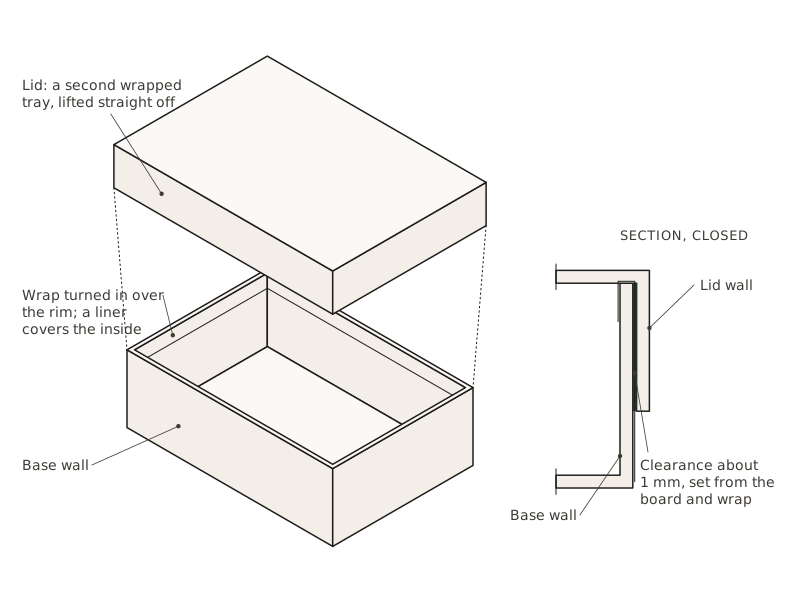
The base and the lid are both trays built the same way: greyboard cut to a panel and four walls, V-grooved or scored at the corners, folded up and held with corner stay tape. Each tray is then wrapped separately, with the wrap turned in over the top edge, typically by 10–20 mm, and a liner covering the inside. Because the two parts are separate, each can have its own wrap, colour or finish.
Fit and clearance
The lid's internal size is the base's external size plus a small clearance, usually around a millimetre, allowing for the board and both layers of wrap. Too tight and the lid will not go on, or will split the wrap at the corners; too loose and it rattles and slides. A good fit lets the lid sink slowly as the air escapes. We calculate the clearance from the board and wrap you choose, which is why we ask for internal dimensions rather than external ones.
Lid depth
A full-depth lid, known as a full telescope, covers the base completely and doubles the wall thickness all round, giving the strongest box and a clean closed block. A partial-depth lid, often a third to half of the base depth, shows a band of the base, is easier to lift off and uses less board. A shallow lid of a few centimetres is common on apparel and document boxes.
Lifting aids
A snug lid is held by friction and air, so deep boxes often include thumb notches: semicircular cut-outs in the base walls that give fingers a grip on the lid rim. A ribbon pull glued under the product or insert lets the customer lift the contents out cleanly. For heavy items, an insert with lift tabs or a ribbon cradle does the same job.
Opening and closing
How it opens and closes
Opening
The lid lifts straight up off the base. On a close-fitting full-depth box this takes a steady pull, often helped by thumb notches or by holding the base down, and the lid releases as air gets in; a partial-depth lid comes away easily. The whole top is then open, so the product is lifted out of the tray rather than revealed on a hinge. The inside of the lid, turned over in the customer's hand, is the first printed surface they see.
Closing
Lower the lid over the base and let it settle: friction between the walls holds it in place, with no magnets, tabs or glue. The closure is only as secure as the fit, so for posting, storage or heavy contents a belly band, ribbon or seal holds the lid on, and an outer carton protects the box in transit. Because nothing wears, the lid fits just as well after many openings as it did on the first.
Best for
Where lid and base boxes work best
Apparel and accessories
Shallow boxes for folded garments, scarves and shirts, with tissue and a printed inner lid.
Fragrance and candles
Deeper boxes with a wrapped board or EVA insert holding the bottle or jar upright.
Electronics
A fitted tray for the device, with accessories in a second layer lifted out underneath.
Gift sets and hampers
Larger boxes where several items sit in a divided insert, usually with a full-depth lid for strength.
Chocolates and confectionery
Shallow two-piece boxes with a divided inner tray, a classic presentation for chocolates and biscuits.
Jewellery and small gifts
Small boxes with a lined platform, the simplest rigid construction at small sizes.
Advantages and limitations
Strengths, and where it falls short
Advantages
- The simplest rigid construction, with no hinge or magnets, so it usually costs less than a magnetic closure box of the same size.
- A full-depth lid doubles the wall thickness, giving good crush resistance and a solid feel in the hand.
- Lid and base can be finished differently, such as a printed lid over a plain coloured base.
- Suits almost any proportion, from shallow apparel boxes to deep cubes and tall boxes.
- Nothing to wear out, so the box survives repeated opening and reuse as storage.
- The whole top opens, which makes loading and unpacking bulky or layered contents straightforward.
Limitations
- Supplied assembled, and lids and bases of the same size do not nest, so storage and freight volume are high.
- The lid is held by friction only, so it can come off in transit unless it is banded, sealed or packed in an outer carton.
- The fit is sensitive: variation in board, wrap and humidity can make a lid tight or loose, which is why the clearance is set by the maker rather than guessed.
- Two separate parts need room at the packing bench, and the customer needs somewhere to put the lid while the box is open.
- Takes longer to produce than a folding carton, because each tray is wrapped and finished separately, partly by hand.
Materials, printing and finishes
What it is made from and how it is decorated
Materials
Greyboard (chipboard)
Typically 1.5–3 mm. Small and shallow boxes use lighter gauges; large, deep or heavy boxes use 2.5–3 mm. Lid and base can differ, as long as the clearance allows for it.
Printed art paper wrap
Coated paper printed in CMYK or Pantone and laminated, the standard choice for full-colour lids.
Speciality papers
Textured, linen-finish, coloured-through and leather-look papers for a tactile surface with foil blocking or debossing.
Kraft paper wrap
Brown kraft for a natural look; takes one or two colour print and foil well, with less vivid colour than coated paper.
Liner and base papers
Cover the inside of each tray and the underside of the base; the lid liner is often printed with a message.
Printing
Each tray has its own wrap, printed flat before assembly: litho for accurate colour on coated paper, or digital for very short runs and versions. Lid artwork must allow for the turn-ins and the depth of the lid walls, because anything on the walls wraps round the corners and text near an edge can be lost in the turn-in; we supply a dieline for each tray. The inside of the lid is the most visible surface after opening, so a message, pattern or instructions often go on the lid liner. Where a partial-depth lid leaves the base walls on show, match the base colour to the lid carefully, since two separate wraps can differ slightly in shade.
Finishes
Lamination
Matt, gloss or soft-touch lamination protects the lid walls, where hands grip and the lid rubs on the base. Lamination is included as standard.
Foil blocking
Applied to the lid top before wrapping; the most common finish on two-piece boxes, in metallic, coloured or holographic foil.
Embossing and debossing
A debossed logo in the lid top holds its shape well in dense greyboard; embossing is kept shallow so it survives wrapping.
Spot UV
A gloss pattern or logo over matt or soft-touch lamination, best on the lid top rather than the walls, which rub against the base.
Inserts, shipping and packing
Practicalities
Inserts
In a two-piece box the insert does most of the presenting, because the product is lifted out of the base. Wrapped board platforms and cradles hold cosmetics, candles and gift sets at the right height; EVA or foam cut to the outline holds glass and electronics; divided card trays organise several items; a ribbon under the insert lets the customer lift everything out at once. Tell us about the insert with your enquiry, because it sets the base's internal dimensions and depth.
Shipping
Lid and base boxes are delivered assembled, usually with the lids fitted on the bases and packed in outer cartons. They cannot be flattened, so plan for the storage volume. To send them on to customers, band or seal the lid and pack each box in an outer courier carton, which also protects the wrap from scuffs. Delivery is included on every order. Your quotation confirms the delivery address and timing.
Packing and assembly
Packing is by hand and simple: lift the lid, load the insert and product, add tissue or a card, and replace the lid. There is no folding, taping or magnet alignment, so it is quick once the boxes are at the bench, but lids and bases need space side by side. If boxes are packed in advance and stored, a band or seal stops lids being lifted or swapped.
Alternatives
When another style does the job better
Box style
Magnetic closure boxes
Keeps the lid attached on a hinge and closes on hidden magnets. Choose it when the reveal matters more than lifting the lid away.
Compare this styleBox style
Shoulder and neck boxes
Adds an inner neck that guides the lid, giving a flush closed box and a contrasting band on opening. Choose it for fragrance, spirits and candles.
Compare this styleBox style
Corrugated lid and base boxes
The same two-piece principle in printed corrugated board: lighter, less expensive and more robust in the post. Choose it for apparel and hampers that travel.
Compare this styleBox style
Collapsible rigid boxes
Choose it when boxes must arrive and be stored flat; the lid is hinged rather than separate.
Compare this style
- Internal dimensions of the base (length × width × depth) and the weight of the contents.
- Lid depth: full depth, partial depth (give the depth you want) or shallow.
- Wrap for lid and base: printed art paper, kraft or a speciality paper, and whether the two differ.
- Printing: lid outside, lid liner and base walls, in CMYK or Pantone.
- Finishes and their positions: lamination, foil blocking, embossing, debossing or spot UV.
- Thumb notches, a ribbon pull, or neither.
- Insert: material, layout and what each cavity holds.
- Quantity (from 50 boxes) and your required delivery date.
Finished work
Lid and base boxes we have made
Lid and base boxes 
Lid and base boxes · Foil blocking 
Lid and base boxes · Greyboard 
Lid and base boxes 
Lid and base boxes · Foil blocking Lid and base boxes Lid and base boxes
Lid and base boxes questions
Questions buyers ask
Anything not covered here, put it in the notes on your quote and we will answer it directly.
Ask on your quoteWhat is a lid and base box?
It is a two-piece rigid box: a wrapped greyboard base and a separate wrapped lid made slightly larger so it slides down over the base. It arrives assembled and closes by friction, with no hinge or magnets.
What is the difference between a full-depth and a partial-depth lid?
A full-depth lid covers the whole base, doubling the walls and making the strongest box. A partial-depth lid covers only the top part, showing a band of the base; it lifts off more easily and uses less board.
Is a lid and base box the same as a telescope box?
Broadly, yes. Telescope is the general packaging term for any box whose lid slides over its base, in rigid board or corrugated. A full telescope has a lid as deep as the base; a partial telescope has a shallower lid.
Why does a good two-piece box close slowly?
Because the fit is close enough that air has to escape between the walls as the lid goes down. A slow, even drop shows the clearance is right; a lid that falls straight down is loose, and one that sticks is too tight.
Should I choose a magnetic closure or a lid and base box?
Choose lid and base when the product is lifted out, the box is deep, or you want the simplest rigid construction. Choose magnetic closure when the lid should stay attached and the contents should be revealed on a hinge. Our comparison guide sets out the trade-offs in detail.
Can lid and base boxes be posted?
Yes, inside an outer carton. The lid is held only by friction, so band or seal it, and pack the box in a courier carton or postal box to protect the wrap and keep the lid on.
What is the minimum order for lid and base boxes?
The minimum order is 50 boxes. Your quotation can show several quantities so you can compare the unit cost.
How long do lid and base boxes take?
Rigid boxes take longer than cartons because each tray is cut, wrapped and finished, partly by hand, and finishes such as foil blocking add a step. Tell us your required delivery date and our team will confirm whether the timing is achievable.
Ready to specify your packaging?
Our team replies during business hours, 10:00–18:00 UK time.